Powerlifting Total Explained: How It Works and Why It Matters
Adrian Callen
Last updated June 4, 2026
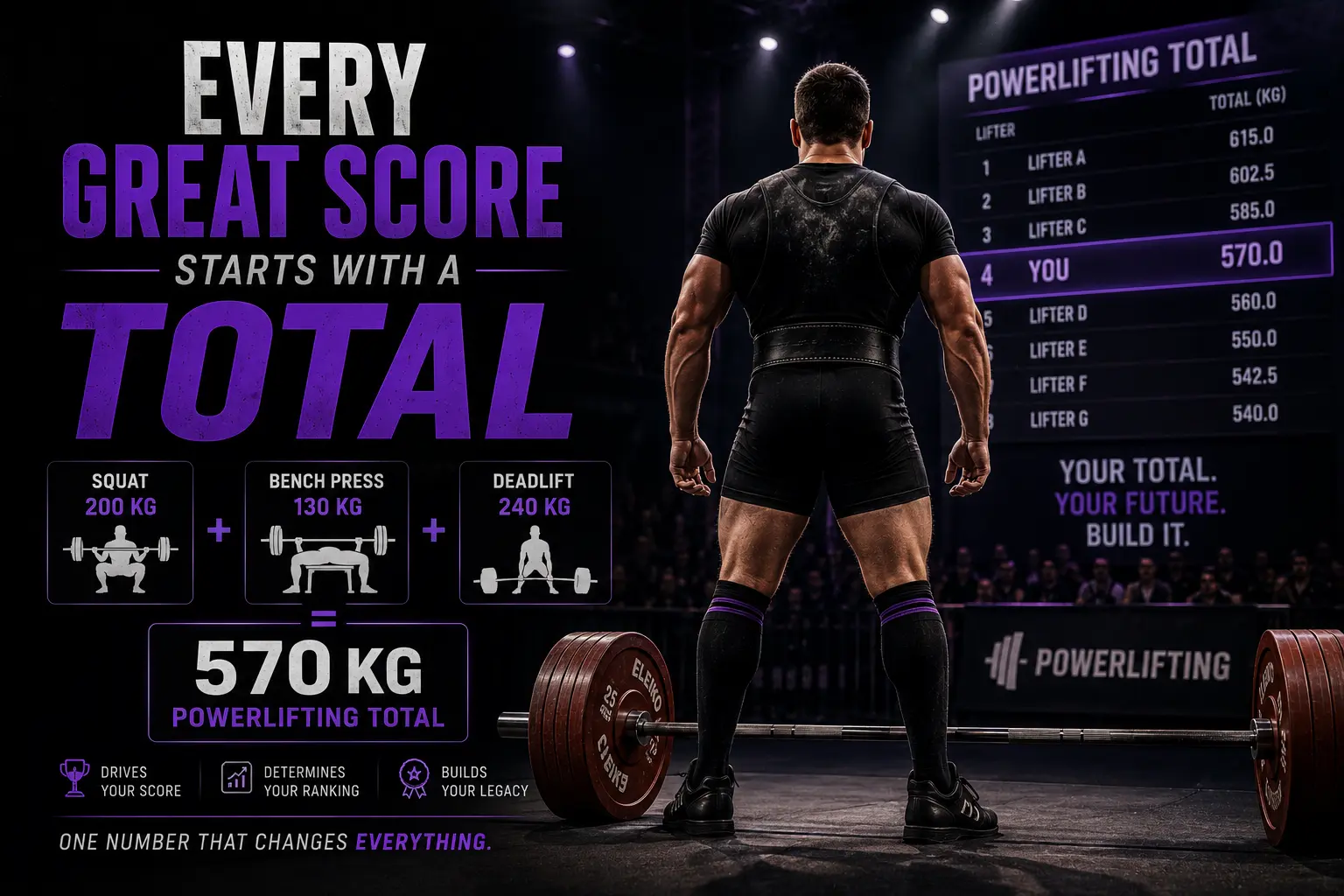
Your squat, bench, and deadlift are three separate numbers. But in powerlifting competition, only one number decides everything.
That number is your total. It determines your placing, your score, and your standing in the sport.
What is a powerlifting total?
A powerlifting total is the combined weight of your best successful squat, bench press, and deadlift in a single competition. It is the foundation of every scoring system in the sport. Without a valid total, you have no official result.
The simple calculation
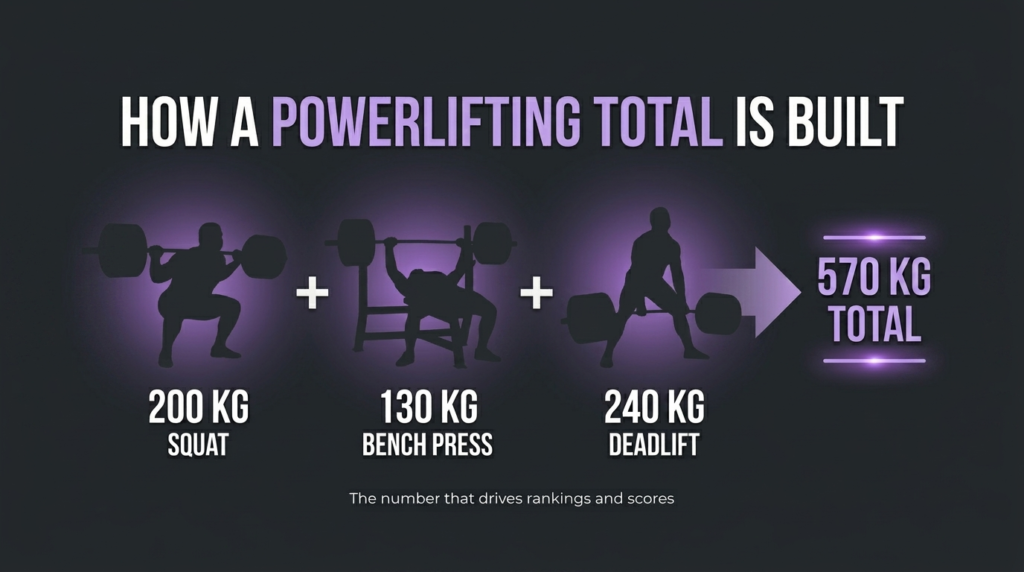
Add your best squat, best bench press, and best deadlift together. A lifter who squats 200 kg, benches 130 kg, and deadlifts 240 kg has a total of 570 kg. That single number is what gets entered into the DOTS, Wilks, and IPF GL formulas. IPF athletes can run their total through the IPF GL calculator to see their official GoodLift score instantly.
How is the total calculated at a competition?
Each lifter gets three attempts at every lift. Your best successful attempt counts toward your total. Failed attempts do not reduce your score. Only your heaviest good lift from each movement is added.
Attempt selection matters
Choosing your attempts wisely directly affects your total. A lifter who opens too heavy and misses their first squat attempt has two attempts left to establish a valid squat. Missing all three attempts on any single lift means no total and no official score for the meet. This is why attempt selection strategy is one of the most discussed topics among competitive powerlifters targeting Best Lifter awards.
What counts as a valid lift?
A lift is valid when the judges give white lights. Most meets use three judges. Two white lights out of three means the lift passes. A red light means a technical fault was called on that attempt.
Common reasons lifts are red-lighted
Squats fail for depth issues, re-racking before the command, or losing control of the bar. Bench press attempts fail for bar movement, feet leaving the floor, or lifting before the press command. Deadlifts fail for hitching, not locking out fully, or dropping the bar before the down command.
A red-lighted lift does not count toward your total. You can retry that weight or go heavier on your next attempt.
How does your total connect to your DOTS or Wilks score?
Your total is the direct input to every relative strength formula. The polynomial coefficient calculation multiplies your total by a bodyweight-specific number to produce your score. A bigger total always produces a bigger score at the same bodyweight.
The relationship is linear
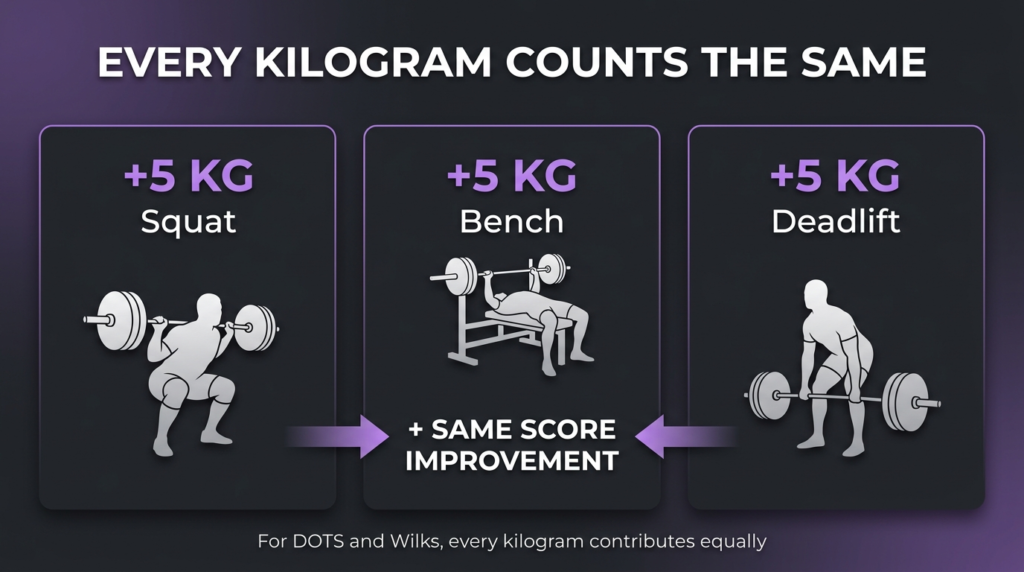
Every kilogram added to your total adds the same amount to your score, regardless of which lift it came from. A 5 kg improvement on bench press is worth exactly the same as a 5 kg improvement on squat or deadlift in terms of score impact.
What is a good powerlifting total?
It depends entirely on your body weight and experience level. A 300 kg total at 59 kg bodyweight is exceptional. That same total at 93 kg bodyweight is a beginner result.
Total ranges by bodyweight for male lifters
| Bodyweight | Beginner total | Intermediate total | Advanced total |
| 66 kg | Under 300 kg | 300 – 420 kg | 420 kg+ |
| 83 kg | Under 380 kg | 380 – 520 kg | 520 kg+ |
| 93 kg | Under 420 kg | 420 – 580 kg | 580 kg+ |
| 120 kg | Under 500 kg | 500 – 680 kg | 680 kg+ |
For context on how these totals translate to actual scores, the beginner through elite benchmark ranges show exactly what each total produces under both DOTS and Wilks.
Does your total change between raw and equipped lifting?
Yes, significantly. Supportive gear adds real kilograms to every lift. A squat suit adds 30 to 80 kg to a squat. A bench shirt adds 20 to 60 kg to the bench press. Equipped totals are not comparable to raw totals at the same bodyweight.
Why this matters for score comparison
Both DOTS and Wilks apply the same formula to equipped and raw totals. A more heavily equipped total produces a higher score even though the extra kilograms came from gear assistance rather than muscle strength. Always compare totals and scores within the same equipment category.
Lifters wanting a deeper breakdown of how gear affects scoring can find the full picture in the equipped vs raw scoring article.
Can you get a total from a single lift meet?
Yes, but it is not a full power total. Bench-only competitions produce a bench total. Push-pull and covering bench and deadlift produce a two-lift total. These are valid within their own divisions but cannot be compared to full-power squat, bench, and deadlift totals.
Most scoring formulas, including DOTS and Wilks, were designed around full power totals. Single-lift and two-lift scores sit on a completely different scale.Use the powerlifting calculator on this page to see how your current squat, bench, and deadlift total translates into a DOTS or Wilks score instantly.
Frequently asked questions
What is a powerlifting total?
A powerlifting total is the sum of your best squat, bench press, and deadlift in a single competition. It is the primary input for all relative strength scoring formulas.
What happens if you miss all attempts on one lift?
You receive no total for that meet. Missing all three attempts on any lift disqualifies you from receiving an official score or placing.
Does a failed attempt count toward your total?
No. Only your heaviest successful attempt on each lift counts. Failed attempts do not reduce your total, but they waste attempts.
Is a higher total always better for your score?
Yes. Every kilogram added to your total raises your DOTS and Wilks score at the same bodyweight. Total growth is the most direct route to a better score.
Can I compare my gym total to competition totals?
Not directly. Competition totals use official commands, judging standards, and weigh-in bodyweights. Gym totals are informal estimates without those controls.
Your Total Is Your Foundation
Every score, every ranking, and every Best Lifter award starts with your total. Build that number, and everything else follows. Enter your current squat, bench, and deadlift into the DOTS and Wilks calculator and see exactly what your total produces under every major scoring formula.