What Is a Good IPF GL Score in Powerlifting?
Adrian Callen
Last updated June 23, 2026
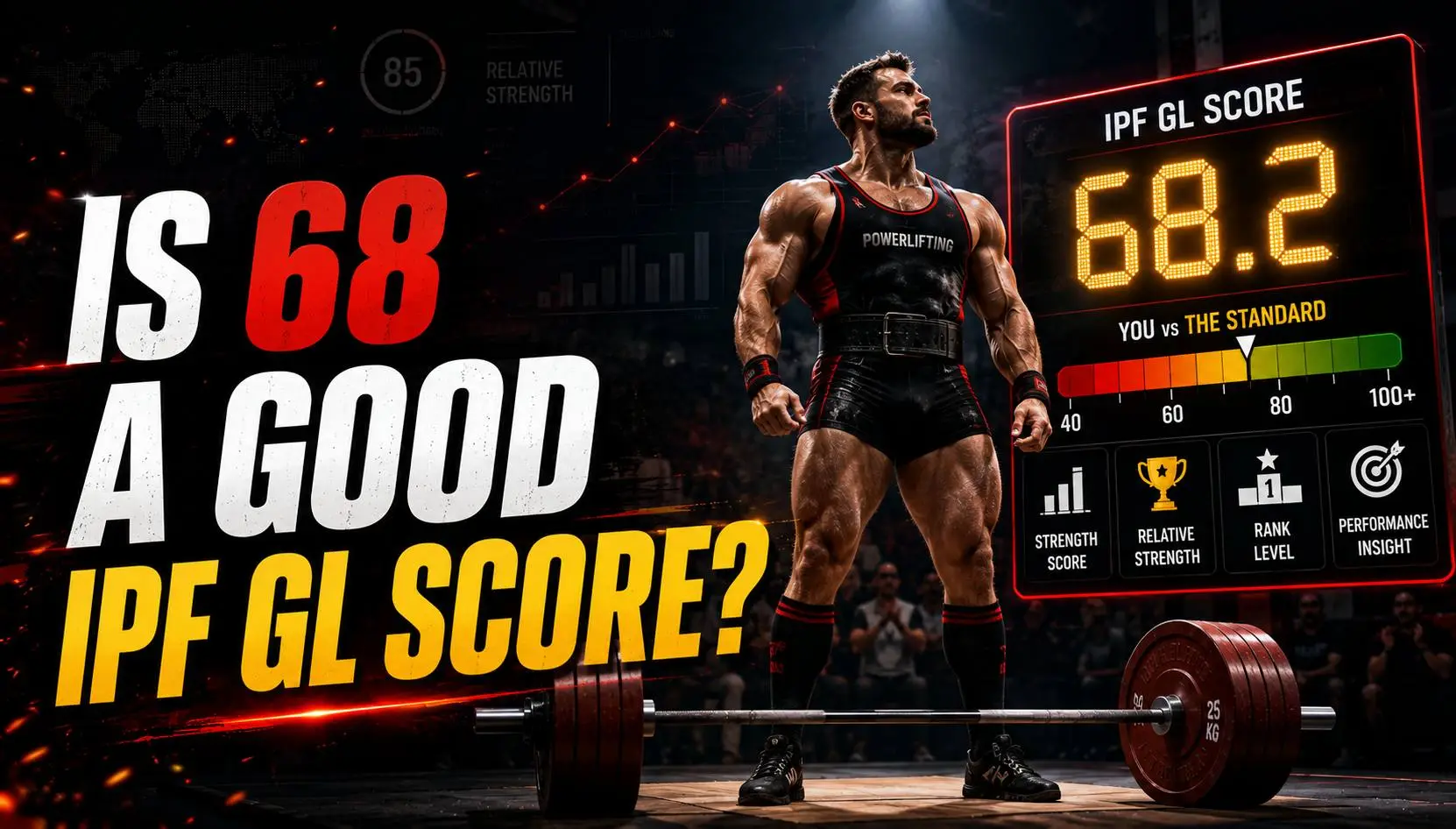
You just got your IPF GL score after a meet. The number is 68. Is that good?
The honest answer depends on your body weight, your division, and how long you have trained. Here is exactly how to read your number.
What is a good IPF GL score?
A good IPF GL score is generally above 60 for raw drug-tested lifters. A score above 75 is advanced. Scores above 85 are elite, and anything above 100 is world-class. These ranges apply across all weight classes since the formula already adjusts for bodyweight.
How the scale works
IPF GL Points run on a different scale than DOTS or Wilks. A score of 100 represents performance close to the elite world-record level. Most lifters never reach that mark, which is exactly why it works as a meaningful ceiling.
If your federation uses DOTS or Wilks, the score ranges will be different. The levels are similar, but the numbers are on a completely different scale.
What IPF GL score should a beginner expect?
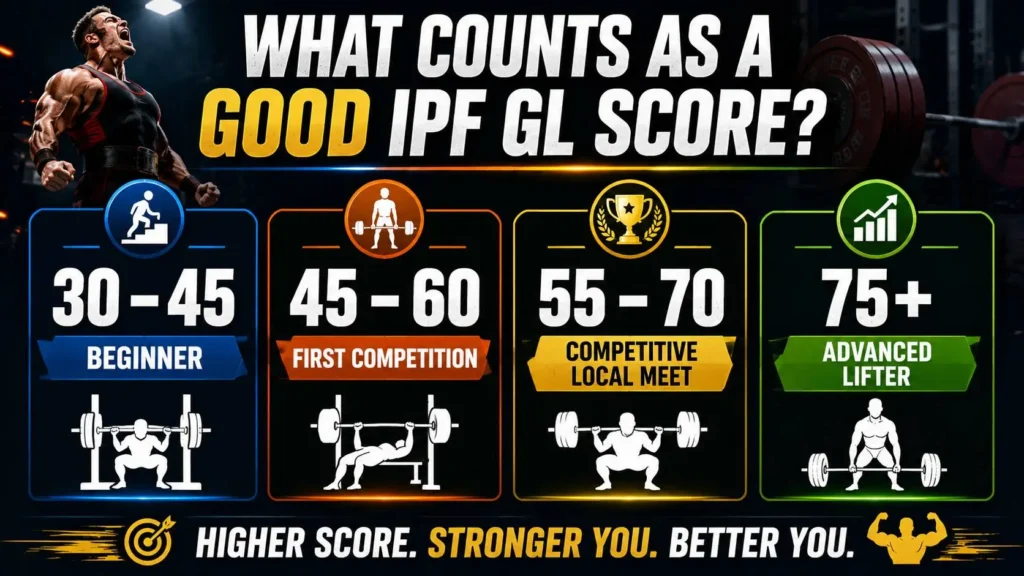
A beginner lifter in their first year of training typically scores between 30 and 45 IPF GL points. Crossing 45 within 12 to 18 months of consistent training is a solid sign of real progress.
What counts as early progress
A first-year lifter who started at 25 and now sits at 40 has made meaningful strength gains relative to their size. The exact number matters less than the upward trend across training blocks.
Track your powerlifting total and score during each training block. This shows whether your strength gains are leading to a higher IPF GL score.
What IPF GL score is competitive at a local meet?
A score between 55 and 70 is competitive at most local and regional USAPL or British Powerlifting meets. Lifters in this range place well in their weight class and sometimes contend for divisional best lifter awards.
Entry-level competition targets
First-time competitors often score between 45 and 60. That range is respectable and puts you ahead of many lifters who never step on the platform. Posting above 60 in your first meet is a strong debut performance.
What IPF GL score is considered advanced?
A score between 75 and 85 is advanced. Lifters at this level often place at state or national qualifying meets. Reaching this range usually takes 3 to 5 years of focused, consistent training.
| Level | IPF GL score |
| Beginner | 30 – 45 |
| Novice | 45 – 60 |
| Intermediate | 60 – 75 |
| Advanced | 75 – 85 |
| Elite | 85 – 100 |
| World-class | 100+ |
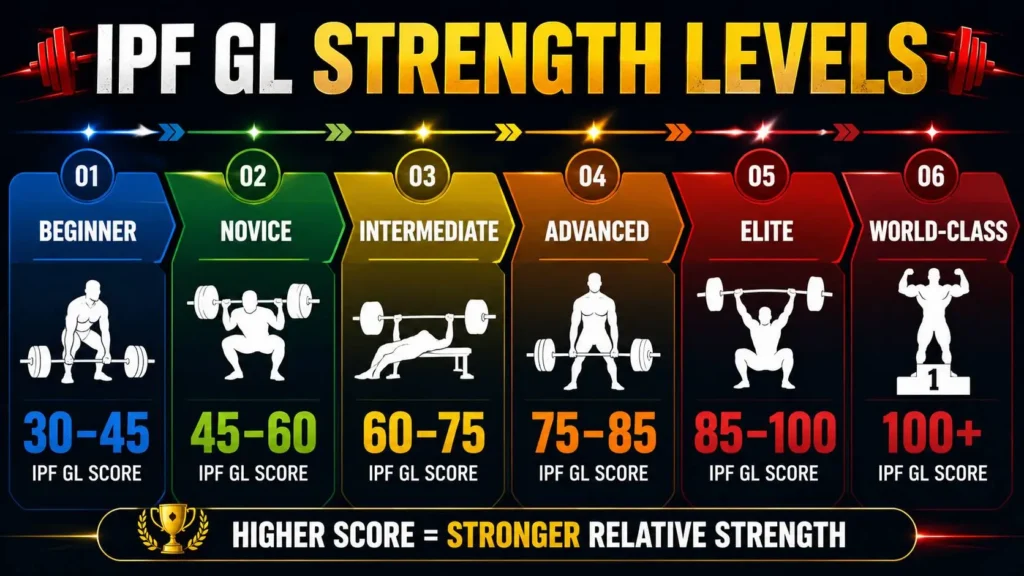
Lifters who want practical strategies for closing the gap between these levels can find them in how to improve your DOTS and Wilks score, since the same training principles apply directly to raising your IPF GL number.
What IPF GL score is considered elite?
An elite IPF GL score sits between 85 and 100. Lifters at this level compete at national championships and often qualify for international team selection.
How rare elite scores are
Fewer than 2% of competitive raw lifters in tested federations ever reach an 85 IPF GL score. Reaching this level typically requires a decade or more of dedicated training alongside strong genetics and consistent programming.
Does a good IPF GL score differ for women?
Yes, the score range stays the same, but the formula uses separate coefficients for female lifters. A 70 IPF GL score for a woman represents the same relative strength level as a 70 for a man.
Female benchmark context
Female lifters competing at IPF affiliate meets see the same general benchmark structure. A 60 to 75 range is competitive at the regional level. Scores above 85 are elite for female lifters in raw-tested divisions.
This mirrors how DOTS and Wilks scores work for female powerlifters, where separate coefficients keep the scale fair across both sexes.
Does equipment change what counts as a good score?
Yes. Equipped lifters typically post higher IPF GL scores than raw lifters at the same bodyweight because supportive gear adds kilograms to the total. Comparing a raw score to an equipped score is not meaningful.
Comparing within the same division
Always compare your IPF GL score only to lifters in the same equipment category, sex, and federation. A 70 raw score and a 70 equipped score do not reflect the same level of underlying strength.
The full breakdown of how DOTS and Wilks handle equipped lifting explains the same equipment-related scoring gap that applies under IPF GL as well.
How can you check where your current score stands?
Run your bodyweight and total through the IPF GL points calculator on this site. Your score appears instantly, and you can compare it directly against the benchmark table above.
If your federation uses a different scoring system, the DOTS score calculator on our homepage calculates both DOTS and Wilks from the same inputs.
Checking your score after every training block shows whether your relative strength is genuinely improving or simply holding steady.
Frequently asked questions
What is a good IPF GL score for a beginner?
A score between 30 and 45 is typical for a first-year lifter. Crossing 45 within 18 months shows strong early progress.
Is a 75 IPF GL score good?
Yes. A 75 IPF GL score is advanced and competitive at state or national qualifying meets in most IPF affiliate federations.
What IPF GL score is considered elite?
A score between 85 and 100 is elite. Fewer than 2% of competitive raw lifters reach this level.
Does a good IPF GL score change for women?
No, the benchmark ranges are the same since the formula uses separate coefficients to keep the scale equal across sexes.
What is the highest possible IPF GL score?
There is no fixed maximum, but scores above 100 represent world record-level performance and are extremely rare.
Know Your Number, Set Your Target
A good IPF GL score depends entirely on where you are in your training journey. Beginners chase 45. Advanced lifters chase 85.
Check your current score using the IPF GL points calculator and find out exactly which range you are in today.