How DOTS and Wilks Scores Are Used for Best Lifter Awards and Team Scoring
Adrian Callen
Last updated April 20, 2026

Winning your weight class is straightforward. The lifter with the highest total wins.
Best Lifter is different. It compares every lifter at the meet regardless of size. That is where DOTS and Wilks scores take over from raw totals completely.
How is the Best Lifter award decided at a powerlifting meet?
The Best Lifter award goes to the lifter with the highest score. This score is based on relative strength, not just total weight lifted. Every lifter who completes all three lifts gets a score. The lifter with the highest score wins. Body weight and total alone do not decide the winner.
Why can raw totals not decide the Best Lifter
A 120 kg lifter will almost always out-total a 60 kg lifter in absolute terms. Using raw totals to pick a best lifter would mean the heaviest weight class wins every time. Relative strength formulas like DOTS and Wilks exist specifically to prevent that outcome.
Which formula decides the Best Lifter at each federation?
The formula used depends entirely on the federation running the meet. USPA and WRPF use DOTS for open Best Lifter decisions. USAPL and all IPF affiliates use IPF GL Points, which you can calculate using our IPF GL calculator before stepping on the platform. World Powerlifting and Powerlifting Australia use Wilks or Wilks2.
At a United States Powerlifting Association meet, the lifter with the highest DOTS score wins. This is across all open weight classes. That lifter gets the Best Lifter trophy. At a USAPL meet the same award goes to the lifter with the highest IPF GL points. The competition is identical in structure. Only the formula changes.
Separate Best Lifter awards by division
Most meets award Best Lifter separately across divisions. Open, junior, master, and sometimes sub-junior divisions each have their own best lifter. Male and female best lifters are also awarded separately. A meet may hand out four to eight Best Lifter awards depending on how many divisions competed.
Understanding which federation uses which formula tells you what score matters. It shows you which number to focus on. This helps you aim for the Best Lifter award at your meet.
How do age coefficients affect Best Lifter in the masters divisions?
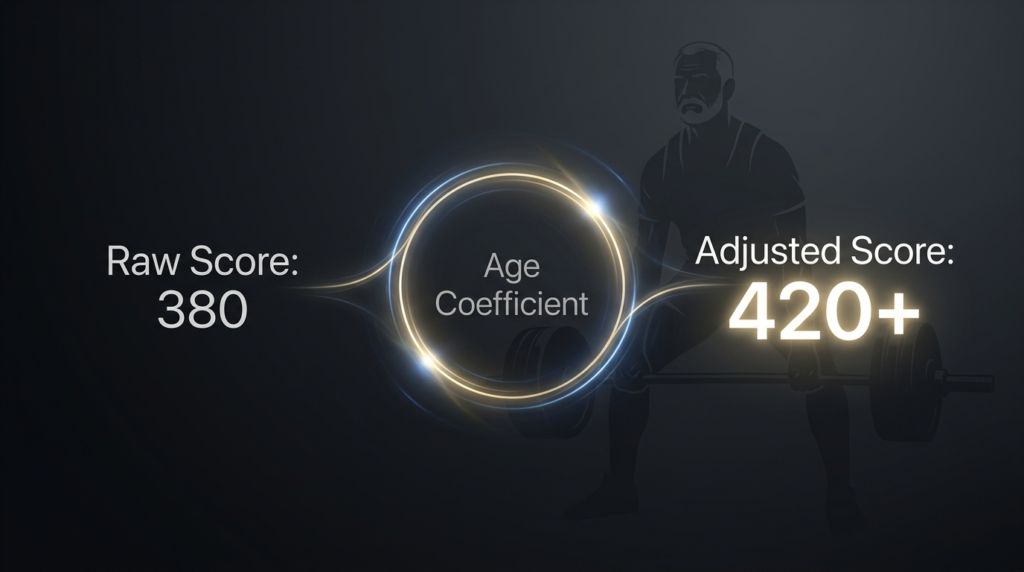
Master’s divisions use an extra adjustment for age. This is added on top of the base DOTS or Wilks score. The most common system is the McCulloch coefficient. It applies a multiplier based on your age. Older lifters get a higher multiplier. This helps account for the natural drop in strength over time.
A 55-year-old lifter might have a DOTS score of 380. After the McCulloch adjustment, that score can rise to 420 or more. The exact number depends on age. In the master’s categories, this adjusted score is what matters. The raw DOTS or Wilks score alone is not used to decide the winner.
Why is the master’s scoring separate from the open
Comparing a 55-year-old lifter to a 25-year-old using raw scores is not fair. The older lifter would be at a disadvantage. That is why an age adjustment is used in masters divisions. It creates a fair comparison within the same age group. At the same time, it keeps the same basic strength scoring system.
The full explanation of age adjustments is covered in the master’s scoring article. It shows how the McCulloch coefficient is applied in competition.
What is team scoring in powerlifting?
Team scoring adds up the scores of lifters from the same team. Each lifter’s score contributes to a combined team total. That total is used to rank teams at the meet. Teams compete against other teams at the same meet. The team with the highest combined score wins.
Different meets use different team scoring rules. Some add the top three DOTS or Wilks scores from a team. Others use the top five. Some weigh the scores equally. Some systems add extra adjustments. They use multipliers based on how many lifters a team has in each weight class. This can change the final team score.
USPA All Stars and DOTS qualifying
The USPA All Stars is an invite-only event. It uses DOTS scores to decide who qualifies. Male lifters usually need a score of 500 or more. Female lifters need around 475 or more. These scores must come from a drug-tested meet. The result can come from any approved competition. It does not have to be a United States Powerlifting Association event.
This means the DOTS score is not just for tracking. It is also required to qualify for the event. Lifters aiming for All Stars need to track their score at every meet. Checking your current numbers helps you see how close you are. It also helps you plan how long it will take to reach the required score.
Can you target a Best Lifter award strategically?
Yes. Attempt selection matters a lot. A lifter who starts safe and makes all nine lifts can get a better score. A lifter who misses big attempts may end up with a lower total. Hitting lifts consistently often leads to a higher final score.
Your best total is your best score. Consistent attempts beat failed heroics whenever “best lifter” is the goal.
Bodyweight management for Best Lifter
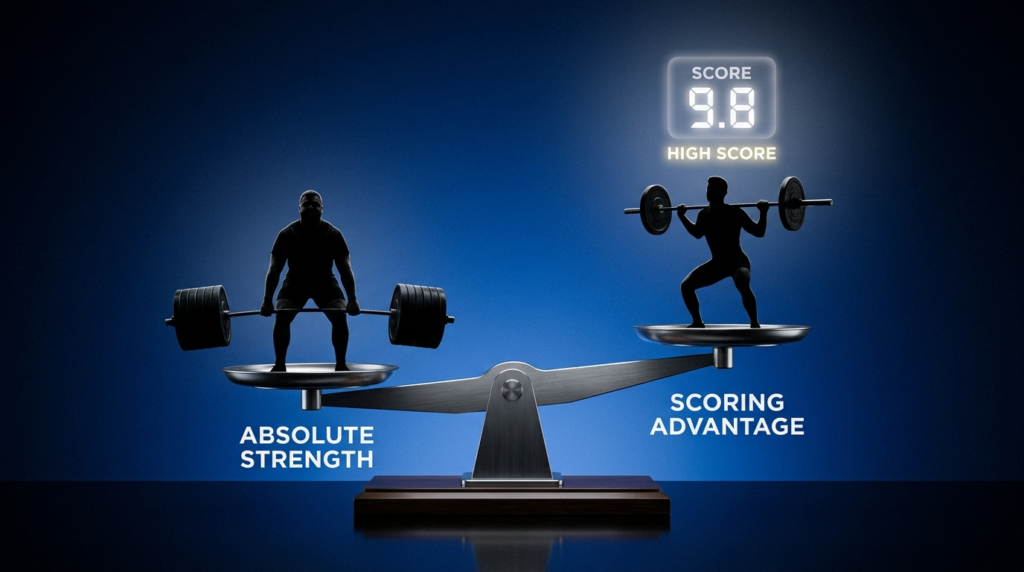
Lighter lifters have an advantage in the scoring system. A 66 kg lifter with a strong total can outscore a 93 kg lifter. This can happen even if the heavier lifter lifts more weight overall. That is why some lifters choose lighter weight classes. It can help them compete for Best Lifter.
The weight cut strategy article explains this in detail. It shows when cutting weight actually helps your score. It also explains when the strength loss is not worth it.
Does your gym total count for Best Lifter?
No. Best Lifter awards at sanctioned meets are based on competition totals only. Gym PRs, training maxes, and estimated totals from training cycles do not count. You need a valid competition total with all three lifts completed to receive a Best Lifter score.
Some federations have extra rules for the best lifter. You may need to compete in the open division to qualify for the overall award. Masters and junior lifters can still win in their own divisions. But they may not be eligible for the overall Best Lifter, depending on the rules.
Frequently asked questions
How is the best lifter decided in powerlifting?
The lifter with the highest relative strength score wins. USPA uses DOTS. USAPL uses IPF GL Points. World Powerlifting uses Wilks.
Can a lighter lifter win Best Lifter over a heavier one?
Yes. Relative strength formulas adjust for bodyweight. A 66 kg lifter with a strong total regularly outscores heavier lifters at well-run meets.
What DOTS score do I need to win Best Lifter?
It depends on the competition. Local meets may be decided by scores of around 380 to 420. National-level Best Lifter winners often score above 480.
Do master lifters compete for the overall best lifter?
It depends on the federation. Some include masters in the overall Best Lifter pool. Others award Best Lifter separately by division.
What is the USPA All Stars qualifying DOTS score?
Male lifters need 500 DOTS from a drug-tested meet. Female lifters need 475 DOTS to qualify at the top registration tier.
The Score Behind the Trophy
Best Lifter is the most meaningful award at any powerlifting meet. It rewards relative strength across all sizes and weight classes.
Your DOTS or Wilks score is the number that decides it. Check where yours stands right now using the powerlifting calculator on this page.