How Are IPF GL Points Calculated in Powerlifting?
Adrian Callen
Last updated July 4, 2026
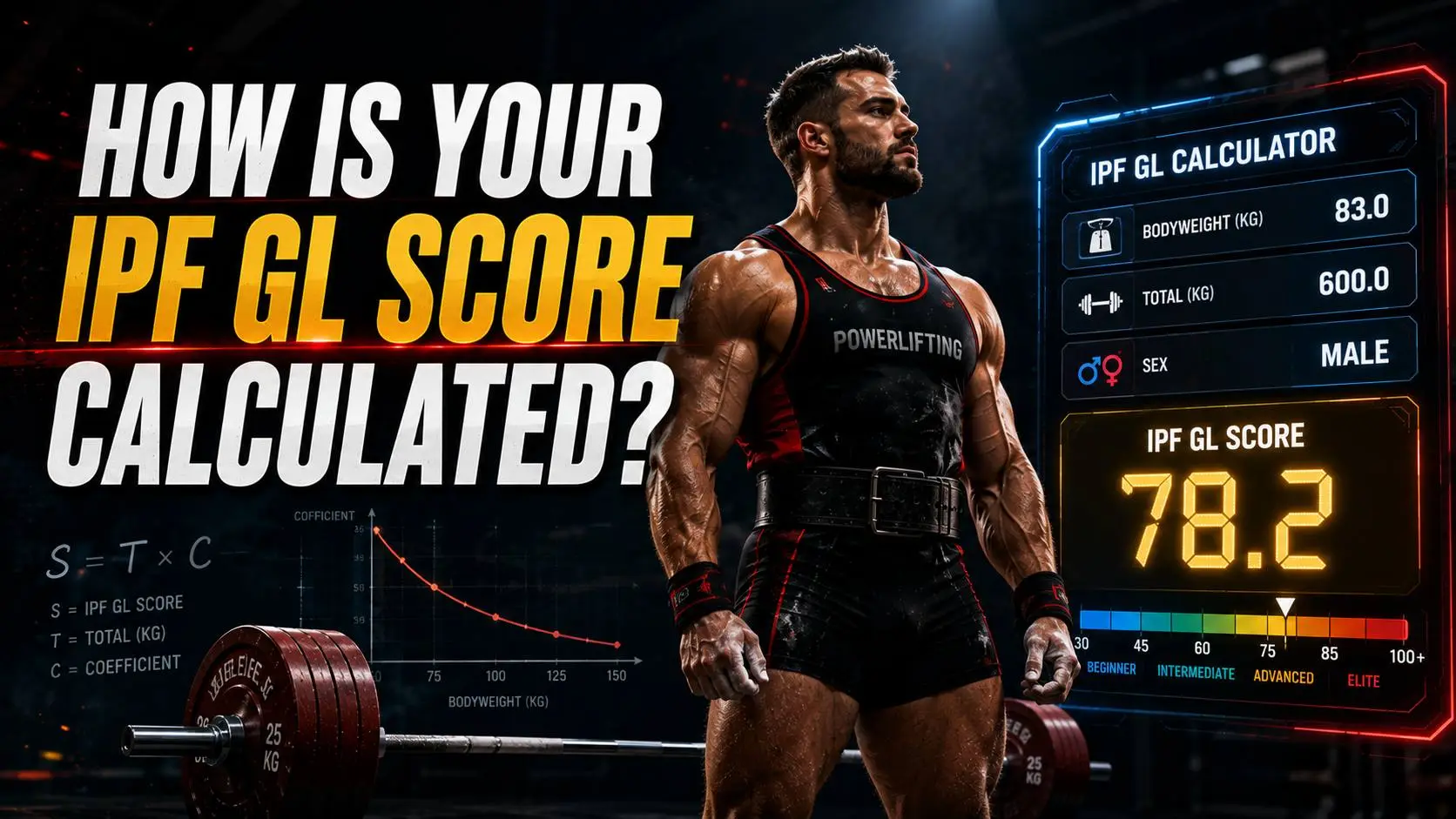
You know your IPF GL score. But how does the math behind it actually work?
Understanding the formula helps you see exactly why your number moves the way it does between meets.
How are IPF GL points calculated?
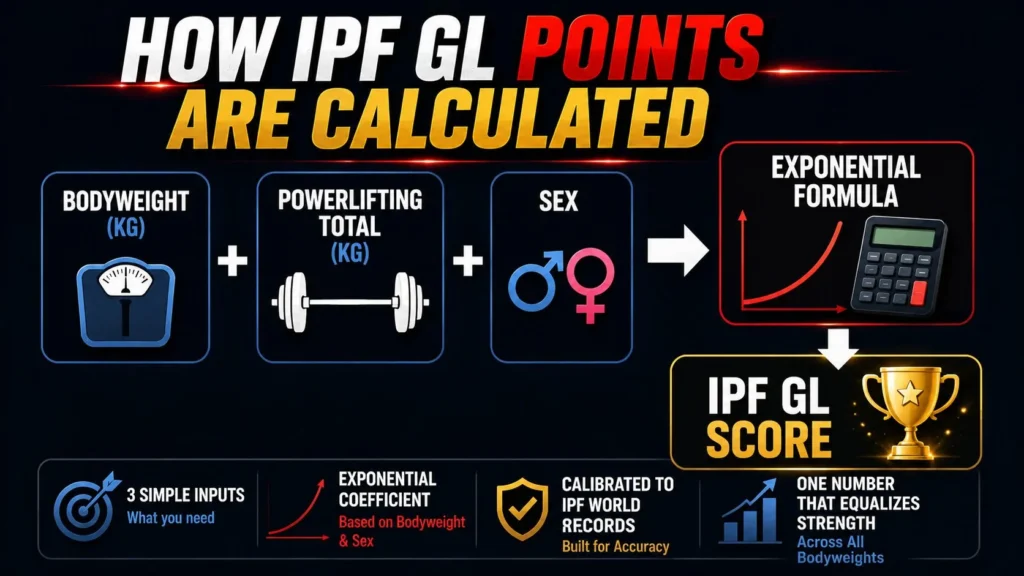
IPF GL points are calculated by multiplying your powerlifting total by an exponential coefficient based on your bodyweight and sex. The formula was built specifically using IPF world record data, which is why it produces a different scale than DOTS or Wilks.
The basic formula structure
Your score equals your total in kilograms multiplied by a coefficient. That coefficient comes from an exponential equation rather than the polynomial used in DOTS and Wilks. The result is a score that typically ranges from 30 to 100 for competitive lifters.
What inputs does the IPF GL formula need?
The formula needs only three inputs. Your bodyweight in kilograms, your powerlifting total, and your sex. No age, no height, and no equipment type factor into the base calculation.
Why only three inputs
Your total is the sum of your best squat, bench press, and deadlift from competition. All three lifts must be valid for the formula to produce a meaningful score. A missing lift means no complete total and no valid IPF GL score.
Why does IPF GL use an exponential formula instead of a polynomial?
IPF GL uses an exponential curve because it was calibrated directly against elite IPF world record performances at every bodyweight. DOTS and Wilks use polynomial curves fitted to broader, more general competition datasets.
What this means for accuracy
The exponential structure produces a tighter, more consistent relationship between bodyweight and coefficient across the full weight class range. This is one reason IPF GL ranked first in the IPF’s own 2020 formula evaluation study.
How does bodyweight affect your IPF GL coefficient?
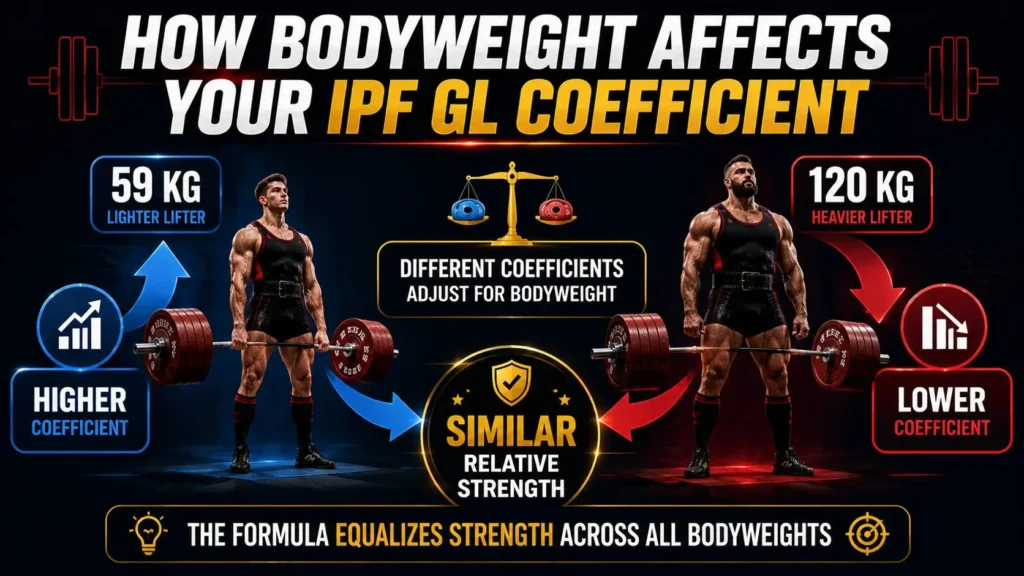
Heavier lifters receive a lower coefficient. Lighter lifters receive a higher coefficient. This adjusts for the fact that absolute strength naturally increases with bodyweight even when relative strength stays the same.
The coefficient curve in practice
A 59 kg lifter and a 120 kg lifter posting equivalent relative performances receive different coefficients that bring their final scores to roughly the same number. That equalizing effect is the entire purpose of the formula.
What does a worked example look like?
Take a male lifter weighing 83 kg with a powerlifting total of 600 kg.
Step one finds the bodyweight coefficient using the male exponential formula at 83 kg. Step two multiplies that coefficient by the total of 600 kg. The result lands at approximately 78 IPF GL points.
That score sits in the advanced range based on the benchmark levels for IPF GL scores, which place 75 to 85 as advanced for raw competitive lifters.
Does the formula differ for male and female lifters?
Yes. IPF GL uses separate exponential parameters for male and female lifters. Both formulas produce scores on the same 0 to 100 scale so that a 70 for a woman represents equivalent relative strength to a 70 for a man.
Why do separate parameters exist
Male and female strength curves scale differently with bodyweight. Using one universal formula would distort the comparison for one sex or the other. Separate parameters keep the final scale fair and consistent across both groups.
Does equipment change the calculation?
Yes. IPF GL applies different coefficient sets for classic raw and equipped divisions. Equipped totals are typically higher due to gear assistance, so the formula adjusts separately to keep equipped scores meaningful within that division.
Comparing raw and equipped results
A raw IPF GL score and an equipped IPF GL score should never be compared directly, even though both use the same underlying exponential structure. Always compare scores within the same equipment category.
Can you calculate your IPF GL score without doing the math yourself?
Yes. The formula involves an exponential equation that is impractical to solve by hand reliably. Entering your bodyweight, total, and sex into the IPF GL points calculator on this site gives you an instant, accurate result.
Running your numbers after every training block lets you track exactly how your score moves as your total and bodyweight change over time.
If your federation uses DOTS or Wilks instead, how those formulas are calculated follows a similar polynomial approach with a different scale entirely.
Frequently asked questions
What formula does IPF GL points use?
IPF GL points use an exponential formula that multiplies your total by a bodyweight and sex-specific coefficient calibrated against IPF world records.
What inputs are needed to calculate IPF GL points?
Three inputs are needed: your bodyweight, your powerlifting total, and your sex. Age and equipment type are not part of the base formula.
Does the IPF GL formula differ for men and women?
Yes. Separate exponential parameters apply for male and female lifters, keeping both on the same 0 to 100 scoring scale.
Why is IPF GL different from the DOTS formula?
IPF GL uses an exponential curve calibrated to IPF world records. DOTS uses a polynomial curve calibrated to broader competition data. They produce different scales entirely.
Can equipped and raw IPF GL scores be compared?
No. The formula applies separate coefficients for raw and equipped divisions. Scores should only be compared within the same equipment category.
The Math Behind Your Number
IPF GL points come down to two things: your total and your bodyweight, run through an exponential formula calibrated to elite world-record data.
Skip the manual calculation. Enter your numbers into the IPF GL points calculator and get your exact score in seconds.