DOTS and Wilks Scores in Equipped Powerlifting: What You Need to Know
Adrian Callen
Last updated May 13, 2026
You compete in a squat suit and a bench shirt. Your total is significantly higher than your raw numbers.
Does your DOTS or Wilks score still mean anything when gear is adding kilograms to every lift?
Do DOTS and Wilks apply to equipped powerlifting?
Yes, but with important limitations. Both formulas calculate your score the same way, regardless of whether you lifted raw or equipped. They multiply your total by a bodyweight coefficient. The formula itself does not change for equipped lifting.
The core problem with equipped scoring
The coefficient curves in both DOTS and Wilks were built on raw competition data. Equipped lifting produces significantly higher totals than raw lifting at the same bodyweight. That inflates the score beyond what the formula was designed to measure.
How does equipment affect your total and score?
Supportive gear adds real kilograms to every equipped lift. A quality squat suit adds 30 to 80 kg to a squat, depending on the lifter and suit type. A bench shirt adds 20 to 60 kg to the bench press. Deadlift suits add less but still contribute meaningfully.
The score inflation problem
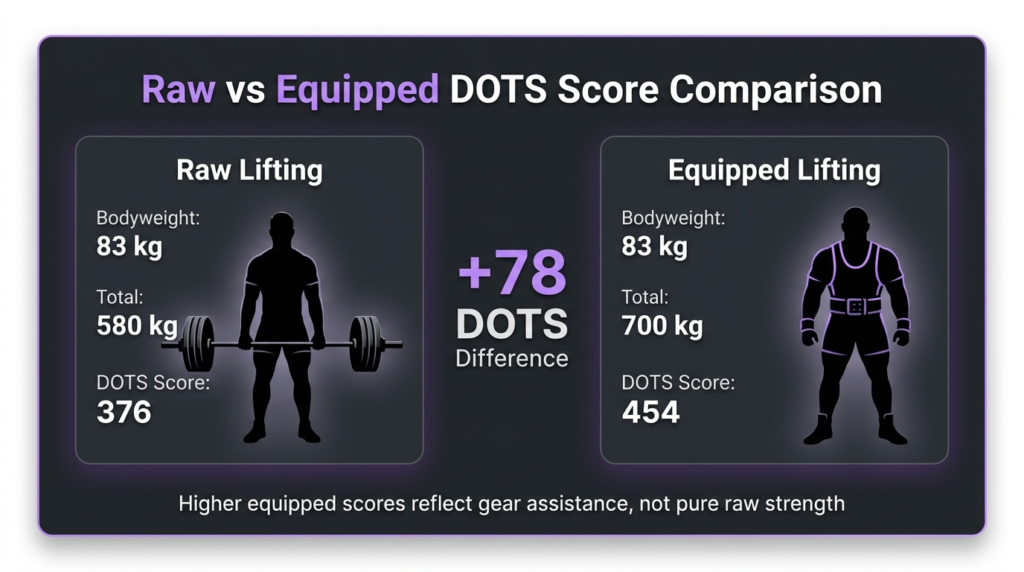
A male lifter at 83 kg posting a 700 kg equipped total scores around 454 DOTS. The same lifter posting a 580 kg raw total scores around 376 DOTS. The 78-point gap reflects gear assistance, not a real difference in underlying strength. The formula cannot separate the two.
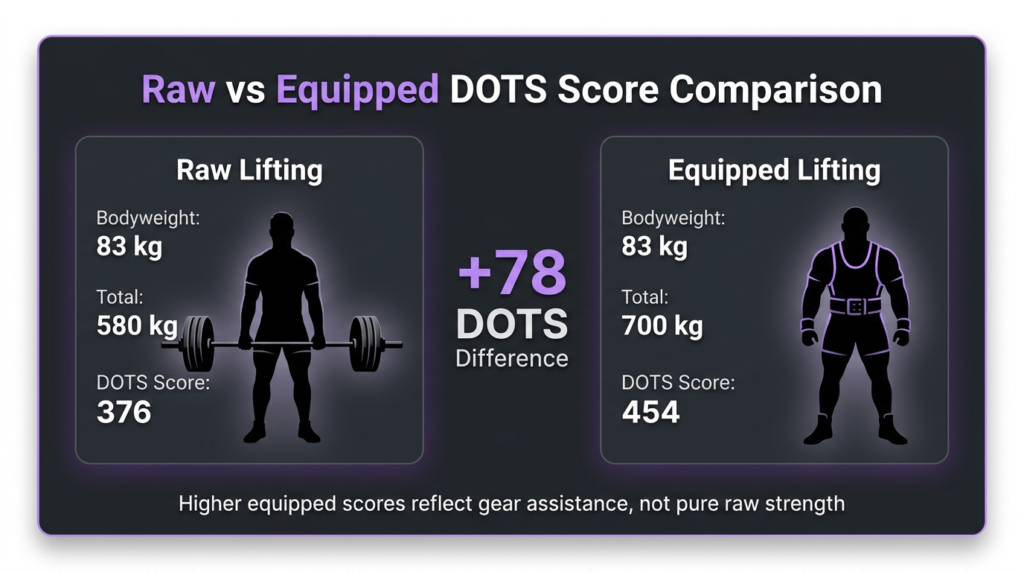
This is why DOTS and Wilks accuracy limitations matter most in equipped divisions. The formulas were not designed to fairly compare equipped and raw performances.
Which scoring systems handle equipped lifting better?
The IPF GL points system uses separate formulas for raw and equipped divisions. Equipped lifters in IPF affiliates can check both raw and equipped results using the IPF GL points calculator. It applies different coefficient curves calibrated specifically to the world record performances. That produces fairer, calibrated scores than applying a raw-calibrated formula to equipped totals.
Most equipped federations still use DOTS or Wilks for best-lifter awards. The comparison is fair when equipped lifters are only compared with other equipped lifters. Everyone must be using the same formula. The federation scoring guide shows which formula each major equipped federation uses.
How federations handle equipped scoring
Most equipped federations still use DOTS or Wilks for best-lifter awards. The comparison is fair when equipped lifters are only compared with other equipped lifters. Everyone must be using the same formula. The federation scoring guide shows which formula each major equipped federation uses.
Can you compare raw and equipped DOTS scores directly?
No. A 420 DOTS from an equipped lifter and a 420 DOTS from a raw lifter are not equivalent performances. The equipped score reflects gear assistance built into the total. The raw score reflects pure muscle strength.
Why direct comparison fails
The fifth-degree polynomial in the Wilks formula and the DOTS coefficient curve were both built using raw lifting data. Applying them to the equipped totals still produces valid scores mathematically. But those scores are not meaningfully comparable to raw scores on the same scale.
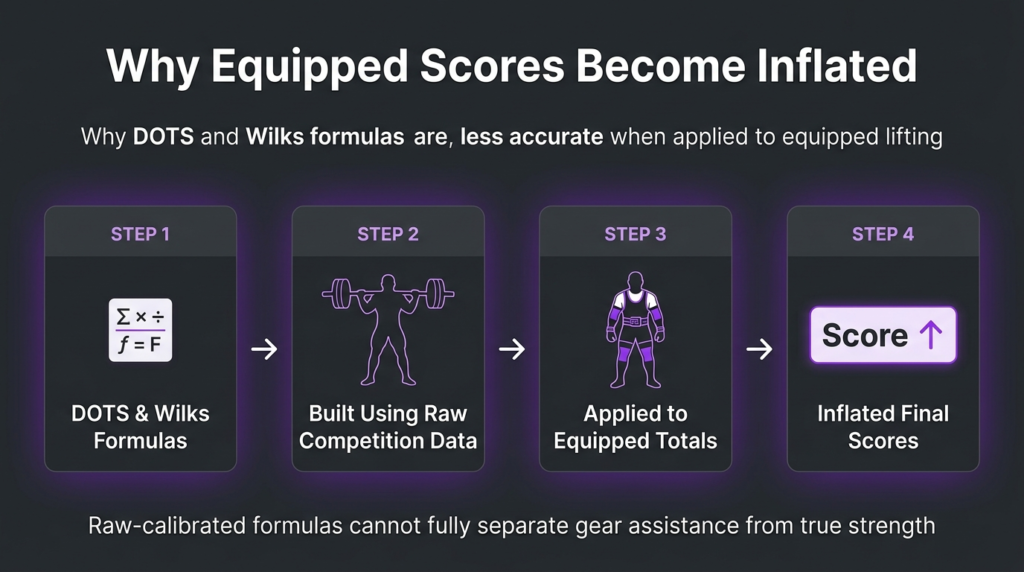
Most serious equipped lifters track their score only within their own division. They also compare scores only within the same equipment category. This is done to keep the comparison fair.
Do equipped lifters score higher than raw lifters at the same bodyweight?
Almost always yes. Gear adds absolute kilograms to your total without adding bodyweight. That pushes the coefficient multiplication higher. An equipped lifter and a raw lifter at the same body weight usually will not have the same score. This is especially true when both compete seriously in their divisions.
The exception at lower levels
At the beginner and novice equipment level, the gear benefit is smaller. Newly equipped lifters often struggle to use their suits and shirts effectively. A novice equipped lifter may score similarly to an intermediate raw lifter at the same bodyweight until they learn to maximize the gear.
Should equipped lifters track DOTS or Wilks for personal progress?
Yes. Even with the raw calibration limitation, your score is still useful in equipped competition. Tracking it across meets gives consistent strength data within your division. If your DOTS or Wilks score goes up, your total is improving faster than your body weight.
Setting equipped score targets
Use the intermediate and advanced benchmark ranges as a starting reference. Add roughly 15 to 25% to those ranges to account for typical gear assistance at your level. That gives you a realistic equipped target without directly comparing yourself to raw standards.
Checking your equipped score after each meet helps you track progress. Using the Wilks and DOTS calculator gives you a consistent way to measure your strength over time.
What about single-ply versus multi-ply scoring?
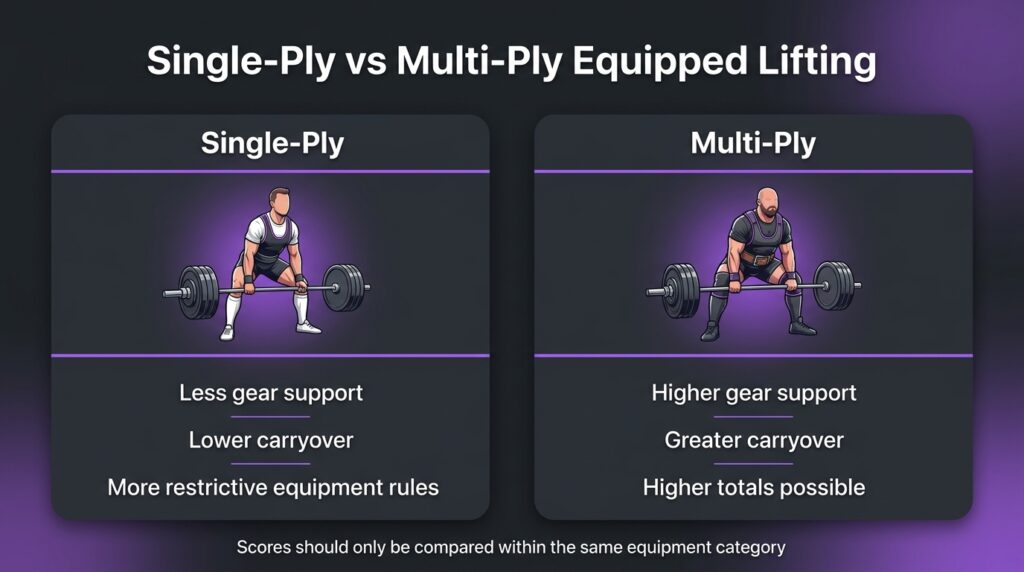
Most federations that allow equipped lifting separate single-ply and multi-ply divisions. Multi-ply gear produces higher totals than single-ply. Comparing scores between those two equipment categories is not fair. It creates the same problem as comparing equipped and raw lifting.
Track within your category only
Single-ply lifters should compare their scores only to other single-ply results. Multi-ply lifters should do the same. Mixing equipment categories can give misleading score comparisons. This happens no matter which formula you use.
Frequently asked questions
Do DOTS and Wilks work for equipped powerlifting?
Yes, but both formulas were built on raw data. Equipped scores are inflated by gear and cannot be fairly compared to raw scores.
Can I compare my equipped DOTS score to raw lifters?
No. Gear adds kilograms to your total without adding strength. Equipped and raw scores are not directly comparable under any formula.
Which formula is best for equipped powerlifting?
IPF GL Points uses separate equipped coefficients. DOTS and Wilks apply the same raw-calibrated formula to equipped totals, which limits their accuracy in equipped divisions.
Does a squat suit affect my DOTS score?
Yes. A squat suit adds kilograms to your squat total. That raises your total and inflates your DOTS score beyond what raw strength alone would produce.
Should equipped lifters still track their score?
Yes. Tracking your score within your own equipped division is still useful. It gives consistent strength data across competitions, even with the raw calibration limitation.
Know What Your Score Reflects
An equipped DOTS or Wilks score measures relative strength within your division. It does not translate directly to raw standards or across equipment categories.
Use it as a within-division benchmark and track the trend over time. That is where the real value sits.