Wilks Score in Powerlifting: What It Is and Why It Matters
Adrian Callen
Last updated April 9, 2026
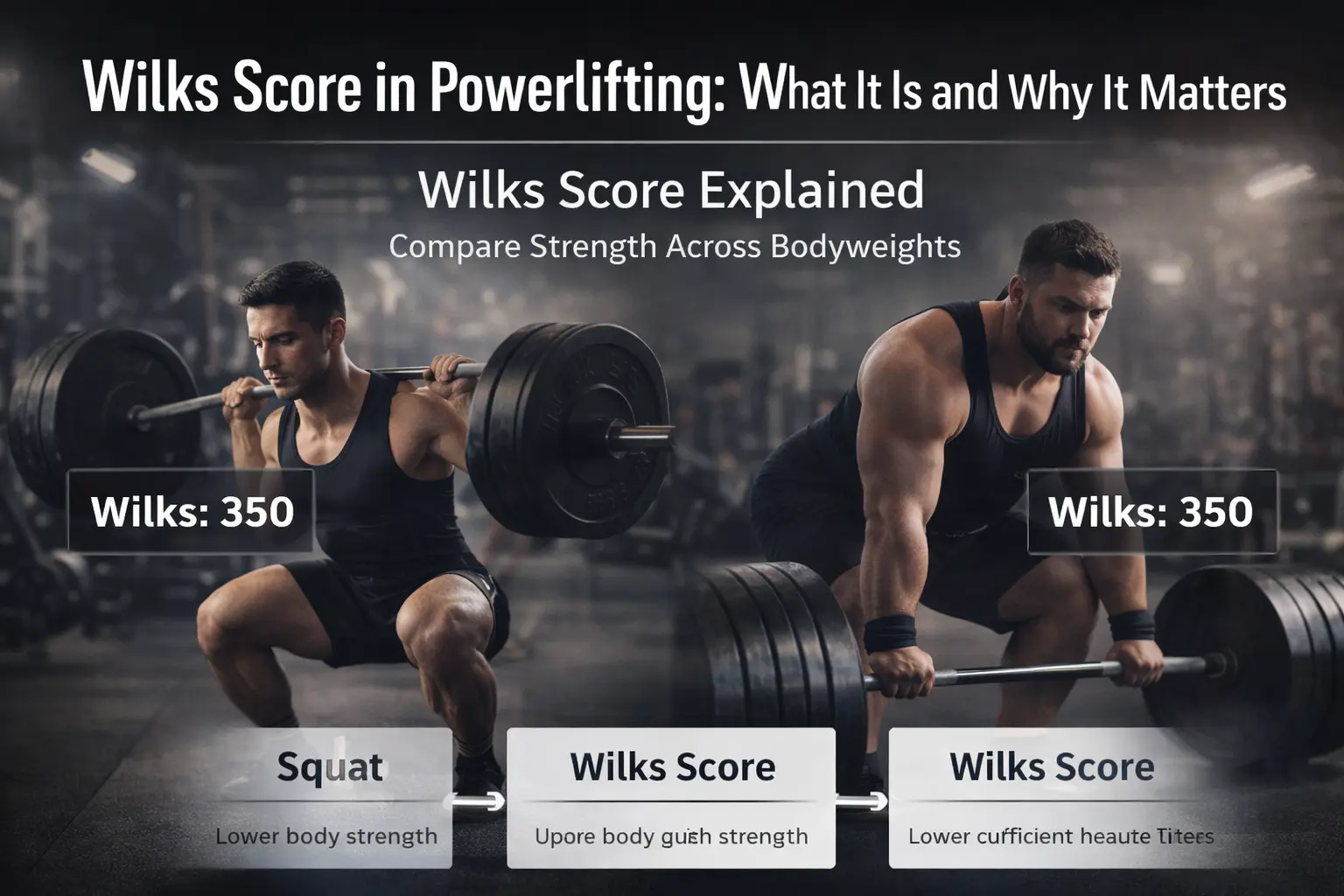
You just hit a big total. But how does it compare to a lifter who weighs 30 kg less?
Raw numbers do not tell the full story. That is the problem the Wilks score was built to fix.
What is a Wilks score?
A Wilks score is a number that measures your strength relative to your bodyweight. It lets powerlifters of different sizes compete on equal terms. A 60 kg lifter and a 100 kg lifter can both earn a 350 Wilks. That number means the same thing for both.
Who created the Wilks score?
Robert Wilks, CEO of Powerlifting Australia, created the formula in 1995. He built it to solve one core problem: absolute totals favor heavier lifters by default. His formula applies a polynomial coefficient to normalize strength across all body weights.
The Wilks score became the global standard for powerlifting comparison. It stayed dominant for nearly 25 years across dozens of federations worldwide.
What lifts go into the Wilks score?
Three lifts make up your Wilks score: squat, bench press, and deadlift. You add your best result from each lift to get your powerlifting total. That total is then multiplied by a Wilks coefficient based on your bodyweight and sex.

All three lifts are required
You need a valid squat, bench press, and deadlift to get a Wilks score. A missing lift means no complete total. No total means no valid score for cross-weight comparison.
How does the Wilks coefficient work?
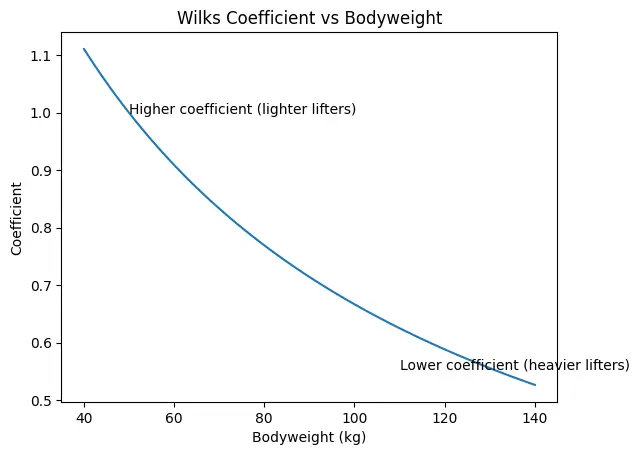
The Wilks coefficient is a number based on your body weight. It is calculated using a complex formula. Lighter lifters get a higher number, while heavier lifters get a lower one. This helps keep things fair, since heavier lifters can usually lift more weight. To get your final Wilks score, you multiply the total lifted by this number. The math behind it is complicated, but you do not need to do it yourself. You can use a calculator to get your score instantly.
Does the formula differ for men and women?
Yes. The Wilks formula uses separate polynomial constants for male and female lifters. The constants differ because strength curves vary between sexes across bodyweight ranges.
Both formulas produce scores on the same scale. A 320 Wilks from a female lifter reflects the same relative strength level as a 320 from a male lifter.
Wilks’ score ranges by level
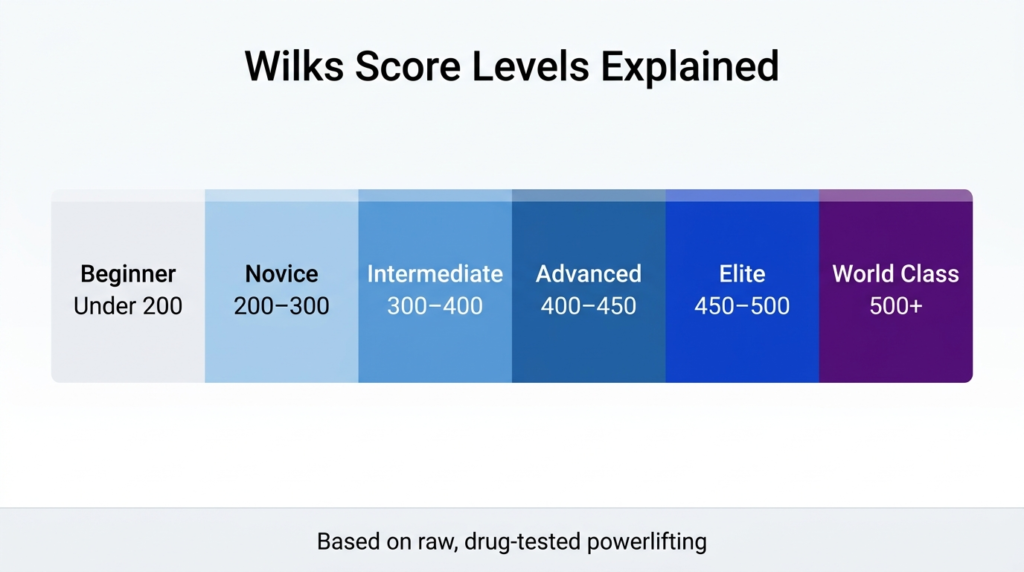
These ranges apply to raw, drug-tested lifting. Equipped divisions and untested federations tend to produce higher scores.
What is a good Wilks score?
A score above 300 means you are lifting seriously. Competitive local lifters typically sit between 350 and 420. Scores above 450 put you in elite territory. Only a small number of lifters in the world exceed 500.
How is Wilks different from DOTS?
Both Wilks and DOTS measure relative strength using bodyweight and total. The main difference is the formula behind each score.
Wilks was built in 1995 using data from that era. DOTS was built in 2019 using a much larger modern dataset. Studies showed Wilks had a slight bias toward middleweight male lifters. DOTS was designed to correct that.
The two scores are not on the same scale. A 380 Wilks does not equal a 380 DOTS. You need to calculate both separately to compare them.
Lifter switching federations often find their DOTS and Wilks numbers differ by 20 to 50 points. Understanding what a DOTS score is helps clarify that gap.
Is the Wilks score still used today?
Yes. Wilks is still used by World Powerlifting, Powerlifting Australia, and several other federations globally. It is no longer the IPF standard. The IPF switched to IPF GL Points in 2020. Many non-IPF federations moved to DOTS around the same time.
Wilks remains one of the most recognized scores in powerlifting. Millions of lifters still track it as a personal benchmark.
Why Wilks still matters for gym lifters
You do not need to compete to use your Wilks score. It works as a simple personal benchmark for anyone training squats, bench, and deadlift. Checking it every few months shows whether your relative strength is actually increasing or just your body weight.
Frequently asked questions
What is a Wilks score in powerlifting?
A Wilks score shows your strength compared to your body weight. It combines your squat, bench press, and deadlift total with a bodyweight coefficient. This gives you one number that can be compared across all weight classes
Is a higher Wilks score better?
Yes. A higher score means stronger performance relative to your size. Scores above 400 are advanced. Above 500 is world class in raw tested powerlifting.
Do men and women use the same Wilks formula?
No. The formula uses separate coefficients for male and female lifters. For a fair cross-gender comparison, both generate scores on the same scale.
Does the Wilks score work without competing?
Yes. Any lifter training squat, bench, and deadlift can calculate a Wilks score. It works as a reliable personal progress tracker outside of competition.
Is Wilks the same as DOTS?
No. Both measure relative strengths but use different formulas and datasets. They produce different numbers and are not directly comparable to each other.
Wrapping up
The Wilks score turns your total into a number you can compare across all weight classes. It has been used in powerlifting for many years and still works well as a personal benchmark today.
You can run your squat, bench, and deadlift numbers through a powerlifting calculator to see exactly where you stand.