How IPF GL Points Work for Women and Masters Lifters
Adrian Callen
Last updated July 17, 2026
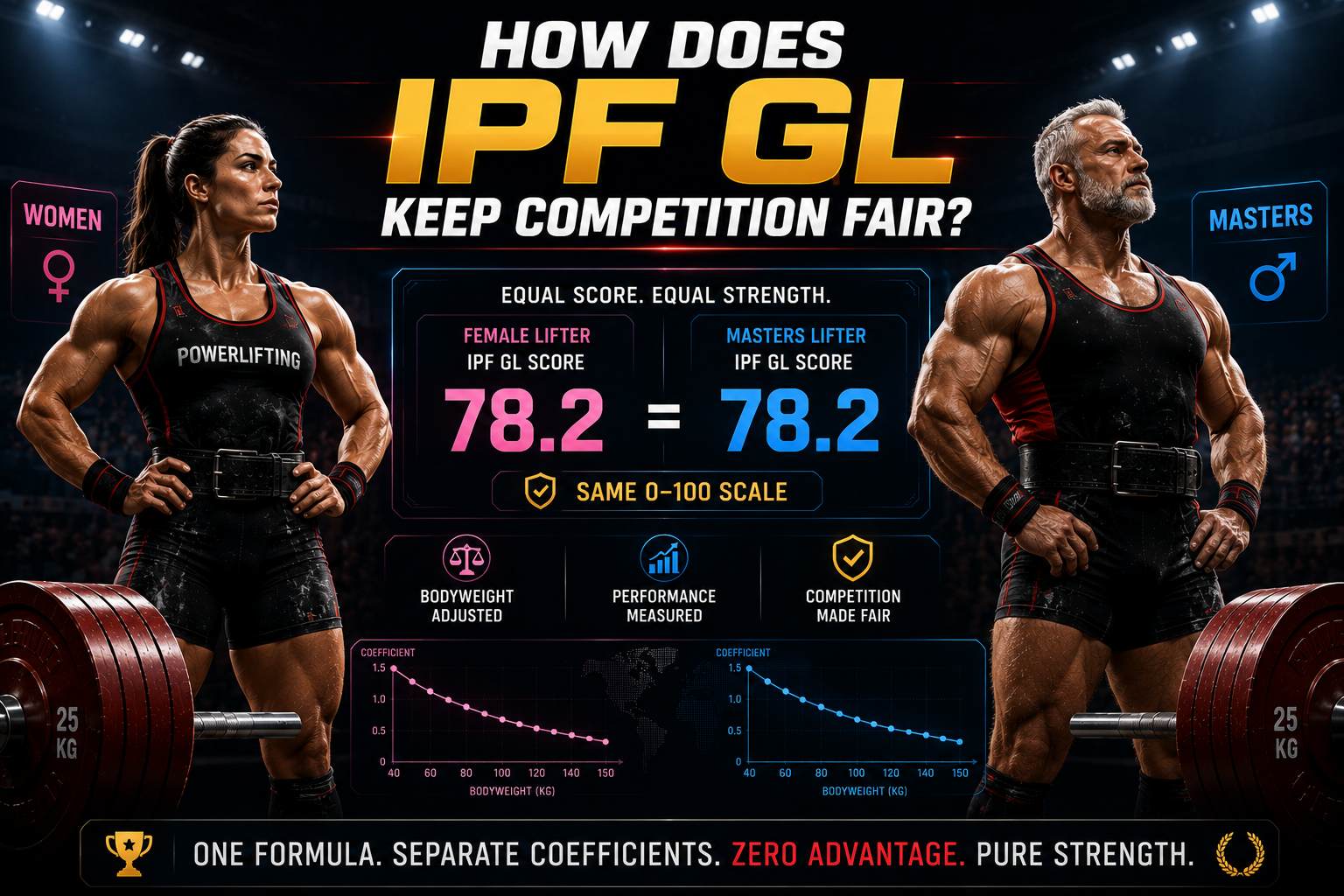
You compete as a female lifter or in a masters division. Your IPF GL score looks different from what you see on the open men’s leaderboard.
That is not a mistake. The formula handles your division differently by design.
Do women use the same IPF GL formula as men?
No. IPF GL uses separate exponential parameters for female lifters. The mathematical constants in the formula differ from the male version. Both produce scores on the same 0 to 100 scale so that equal scores represent equal relative strength regardless of sex.
Why separate parameters exist
Male and female strength curves scale differently across bodyweight ranges. A single universal formula would systematically favor one sex over the other at certain bodyweights. Separate parameters correctly and keep the scoring scale fair across both groups.
What is a good IPF GL score for female lifters?
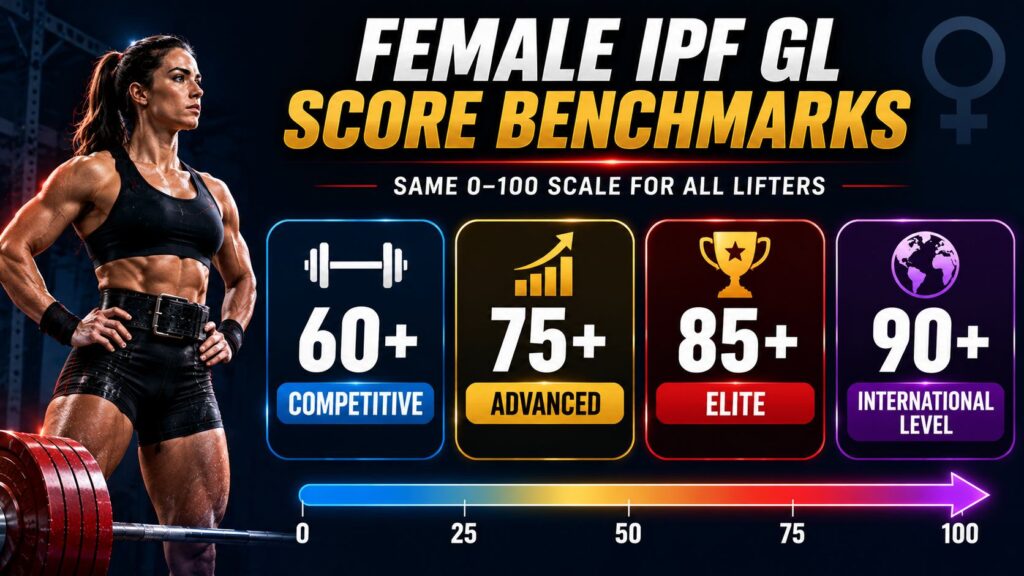
The benchmark ranges are the same for both sexes since the formula equalizes across genders. A score above 60 is competitive at local meets. Above 75 is advanced. Above 85 is elite for female lifters in raw drug-tested competition.
Female competition context
Female lifters at regional USAPL or British Powerlifting meets typically score between 55 and 75. National-level female competitors often sit between 75 and 90. Scores above 90 represent the upper tier of international female competition.
This mirrors the general IPF GL benchmark structure covered in detail with the full level-by-level table.
Which bodyweight range gives the most accurate female IPF GL score?
Female lifters between 57 kg and 84 kg sit in the most statistically reliable part of the exponential curve. The IPF GL formula for women is valid between 40 kg and 150 kg. Outside that range, the formula extrapolates beyond its calibration dataset.
What this means in practice
A female lifter at 47 kg and one at 140 kg both receive valid scores, but those at extreme ends of the range have slightly less reliable coefficients than lifters in the middle bodyweight classes. This is a limitation of every scoring formula currently in use, not just IPF GL.
Do IPF GL points account for age in masters divisions?
No. The base IPF GL formula does not include age as an input. It only uses bodyweight, total, and sex. Age adjustments for master lifters are applied separately on top of the base score.
How masters age adjustment work in IPF competition
IPF-affiliated federations apply the McCulloch coefficient to base IPF GL scores for masters divisions. This multiplier increases with age. A 55-year-old master lifter receives a higher multiplier than a 42-year-old. The resulting age-adjusted score decides the best lifter in the masters categories.
A master lifter with a base IPF GL score of 72 at age 58 might receive a McCulloch multiplier of around 1.18. That produces an age-adjusted score of approximately 85, which is elite territory even though the base score sits in the advanced range.
Which age groups qualify for masters divisions in IPF competition?
Masters divisions in IPF-affiliated meets start at age 40. Sub-divisions run in 10-year increments.
| Division | Age range |
| Masters 1 | 40 – 49 |
| Masters 2 | 50 – 59 |
| Masters 3 | 60 – 69 |
| Masters 4 | 70 and above |
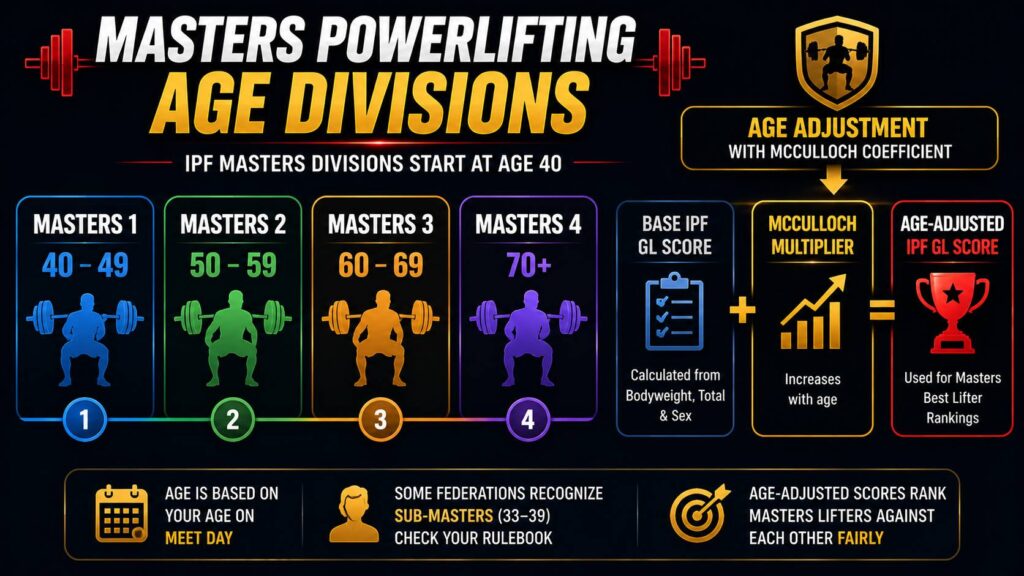
Some federations also recognize a sub-masters category for lifters between 33 and 39. Check your specific federation rulebook for exact age division rules.
How age-adjusted scores work at the competition level
Your base IPF GL score is calculated first. The McCulloch multiplier is then applied based on your exact age on meet day. That adjusted number is what appears on the official best lifter ranking for your masters division.
The full explanation of how age coefficients layer on top of base scores covers the McCulloch system in detail, which applies identically whether your base score is DOTS, Wilks, or IPF GL.
Can masters lifters compare their base IPF GL score to open division lifters?
Yes, using base scores only. A 45-year-old master’s lifter with a base IPF GL score of 68 and a 27-year-old open lifter with a 68 are posting equivalent relative strength. Age is not in the base formula.
When comparison breaks down
Age-adjusted scores exist only for the master competition context. They should never be compared to open division scores. The multiplier inflates the number specifically to rank master lifters against each other fairly, not to compare them to younger athletes.
Should women and masters lifters track both base and adjusted scores?
Yes. Tracking both numbers gives a complete picture of progress.
Your base IPF GL score tells you whether your absolute relative strength is improving. Your age-adjusted score tells you how your performance holds up within your master’s division over time.
A rising base score during a period when the age-adjusted score stays flat means the McCulloch multiplier is doing more work than your actual strength gains. That is a useful training signal.
Use the IPF GL points calculator to check your base score after each training block. Record it alongside your total and bodyweight for the most useful tracking data.
If you also want to track your DOTS or Wilks scores alongside IPF GL, the DOTS score calculator on our homepage calculates both systems from the same inputs instantly.
Frequently asked questions
Do women get a different IPF GL score than men for the same performance?
No. Separate parameters keep both sexes on the same scale. Equal scores represent equal relative strength regardless of sex.
Does IPF GL account for age automatically?
No. Age adjustments use the McCulloch coefficient applied separately on top of the base IPF GL score in masters divisions.
What is a good IPF GL score for a master’s lifter?
A base score above 65 is competitive for master lifters. Age-adjusted scores above 80 are advanced in most master’s divisions.
Which IPF GL parameters apply to female lifters?
Female lifters use separate exponential constants in the IPF GL formula. Both male and female parameters produce scores on the same 0 to 100 scale.
Can I compare my master’s IPF GL score to open division results?
Only using base scores. Age-adjusted scores apply within the masters competition only and should not be compared to open division performances.
Your Division, Your Score
IPF GL handles women and master lifters through separate coefficients and age adjustments that keep competition fair at every level.
Track your base score consistently using the IPF GL points calculator and watch the trend across training blocks. That trend tells you more than any single result ever will.