Wilks2 in Powerlifting: What Changed in the 2020 Formula Update
Adrian Callen
Last updated April 12, 2026
You open a powerlifting calculator and see two options: Wilks and Wilks2.
Most lifters pick one without knowing what separates them. The difference matters more than you think.
What is Wilks2?
Wilks2 is an updated version of the original Wilks formula, released in March 2020. Robert Wilks rebuilt it using newer competition data to fix the issues in the 1995 version. The way the formula works stayed the same, but the numbers inside it were updated.
The quick answer
Wilks2 is the 2020 update of the Wilks scoring formula. It gives more accurate strength scores than the original, especially for very light and very heavy lifters.
Why did the Wilks formula need an update?
The original Wilks formula was built on 1995 competition records. The sport grew enormously over the following 25 years. The dataset behind the original formula could not represent modern powerlifting populations accurately.
The most documented problem was bias at extreme body weights. Very light lifters were underscored. Very heavy lifters were overscored in some weight ranges. Middleweight male lifters had an unfair advantage. This advantage was not based on their actual strength.

What the data showed
In early 2020, the International Powerlifting Federation reviewed several scoring formulas. They checked how fair each formula was across different weight classes. They also looked at how well it ranked lifters based on real performance. The original Wilks formula did not perform well at very low and very high body weights. It was clear that an update was needed.
What exactly changed in Wilks2?
The core structure of Wilks2 is identical to the original. Both use a fifth-degree polynomial equation. Both multiply your powerlifting total by a bodyweight coefficient. The difference is in the specific constants used inside that polynomial.
Robert Wilks updated the formula using more recent competition data. He used a larger set of results to make it more accurate. The new constants produce a smoother coefficient curve. Scores for lifters at extreme bodyweights shifted noticeably. Scores for middle bodyweight lifters changed by a smaller margin.
How much do the scores differ?
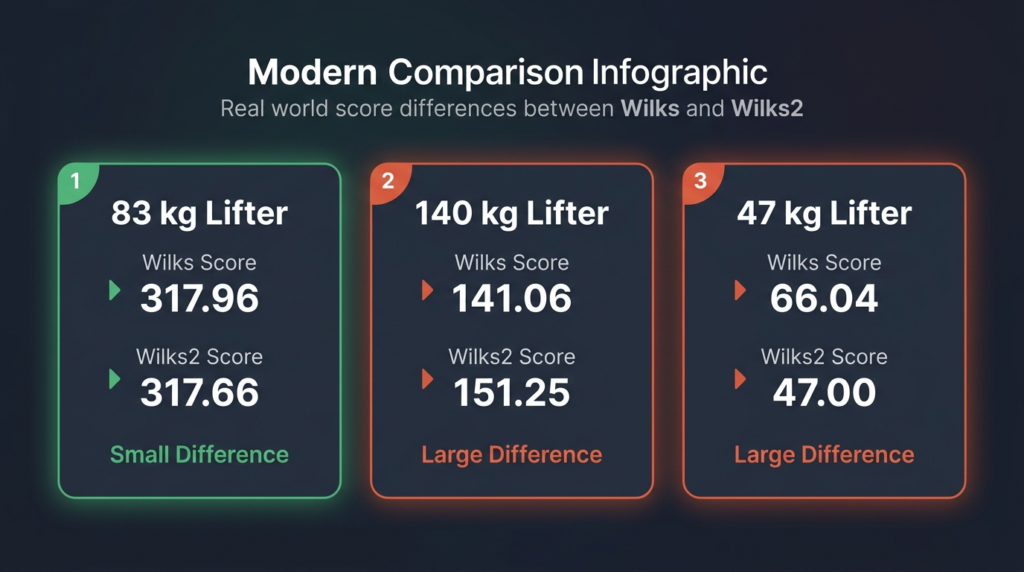
For a male lifter at 83 kg, the difference between Wilks and Wilks2 is small, often just a few points. For a male lifter at 140 kg or a female lifter at 47 kg, the gap can be 15 to 30 points. The update matters most if you compete at the lighter or heavier end of the weight class spectrum.
Is Wilks2 more accurate than the original Wilks?
Yes, but with context. Wilks2 ranked third in the IPF’s 2020 formula evaluation. The original Wilks ranked last in several categories. DOTS ranked second. IPF GL Points ranked first overall.
Wilks2 is a clear improvement over the original formula. It gives fairer results, especially for lifters at the extremes of body weight. However, it is not the most accurate system available today. If your federation still uses Wilks, the 2020 version is a better option than the old one.
To see how it compares with newer systems, check a full comparison of all major scoring formulas side by side.
Who uses Wilks2 today?
Powerlifting Australia is the most prominent federation using Wilks2 as its official scoring system. Several smaller national federations have also adopted it. Most major federations that moved away from the original Wilks chose DOTS rather than Wilks2.
Why most federations skipped Wilks2
The IPF had already developed its own replacement by the time Wilks2 was published. Non-IPF federations such as USPA and WRPF moved to DOTS around the same time. Wilks2 arrived during a moment when the sport was already splitting into two camps: IPF GL and DOTS. There was little room left for a third option.
Can you compare Wilks and Wilks2 scores directly?
No, you cannot compare them directly. Both formulas give different scores for the same lifter. So, a 390 on the original Wilks is not the same as a 390 on Wilks2. If your federation switched from Wilks to Wilks2, your old scores and new scores will not match. Because of this, they should not be compared directly over time. Always note which version was used when recording your score. The difference is small for most lifters but real enough to matter at the competitive level.
Which version should you calculate?
Use the formula your federation uses in competition. That is the one that matters most. For personal tracking, Wilks2 gives a more accurate picture of your strength than the original. You can also run both versions to see how your score changes between them. The full history of these formulas explains why the 1995 version was used for so long before it was updated.
Frequently asked questions
What is Wilks2 in powerlifting?
Wilks2 is the 2020 updated version of the original Wilks formula. It uses recalibrated constants to produce fairer scores at extreme body weights.
Is Wilks2 better than the original Wilks?
Yes. Wilks2 corrects known biases in the 1995 formula. It scores lifters more accurately at very light and very heavy bodyweights.
Who uses Wilks2?
Powerlifting Australia is the main federation using Wilks2 officially. Most other federations moved to DOTS or IPF GL Points instead.
Is Wilks2 the same as DOTS?
No. Wilks2 is a revised version of the Wilks formula. DOTS is a completely separate formula built by a different person using a different mathematical approach.
How much does my score change between Wilks and Wilks2?
For most lifters in middleweight classes, the difference is under 10 points. At extreme body weights, the gap can reach 15 to 30 points.
Bottom Line
Wilks2 is a better version of the original Wilks formula. It fixes real scoring problems without changing the fundamental approach. Whether it matters to you depends entirely on which federation you compete in.
Pull up the calculator and run your numbers under both Wilks versions to see exactly how they compare for your body weight and total.