DOTS vs Wilks vs IPF GL: Which Powerlifting Scoring System Should You Use?
Adrian Callen
Last updated April 13, 2026
Three different formulas. Three different numbers for the same lifter. If you compete across federations or just want to track your strength honestly, knowing which system to use makes a real difference.
What are the main powerlifting scoring systems?
Three formulas dominate powerlifting today: DOTS, Wilks, and IPF GL Points. All three measure relative strength by adjusting your total for bodyweight. Each uses a different mathematical approach and was built on a different dataset.
Why there are multiple systems
There is no single formula used everywhere. The International Powerlifting Federation uses IPF GL only. Other federations are split between DOTS and Wilks. Knowing the difference helps you understand which score actually matters for you.
What is DOTS and how does it work?
DOTS is a scoring system created in 2019 by Tim Konertz using modern competition data. It calculates a number based on your body weight. This number is then multiplied by your total to give your score. The goal of DOTS was to fix the problems in the original Wilks formula. It gives more consistent results across all body weights. That is why federations, such as the United States Powerlifting Association and the World Raw Powerlifting Federation, started using it in 2020.
Who uses DOTS today
USPA, WRPF, and several other major non-IPF federations use DOTS for best lifter awards and rankings. It is the most widely used formula outside the IPF ecosystem.
What is the Wilks formula and how does it work?
Robert Wilks introduced the Wilks coefficient in 1995. It uses a fifth-degree polynomial built on competition data from that era. For nearly 25 years, it was the global standard across powerlifting federations worldwide.
The original formula had documented biases at extreme body weights. The 2020 update, known as Wilks2, recalibrated the constants to address those problems. Powerlifting Australia uses Wilks2 as its current official system.
Where Wilks still holds ground
World Powerlifting and several national federations still use the original Wilks or Wilks2. For lifters competing in those federations, the Wilks score remains the number that counts at the platform. The full story of how Wilks was built and why it eventually lost ground is covered in the scoring history article on this site.
What is IPF GL and how does it work?
IPF GL Points, also called “Goodlift Points,” became the official IPF scoring system in May 2020. You can calculate your score using the IPF GL points calculator directly. Unlike DOTS and Wilks, IPF GL uses an exponential curve rather than a polynomial. It was calibrated specifically against IPF world-record performances.
The IPF’s own 2020 evaluation ranked IPF GL first for scoring accuracy and consistency across weight classes. However, that calibration is specific to IPF competition data. Outside the IPF, the formula loses some of its accuracy advantage.
IPF GL vs DOTS vs Wilks accuracy
In the IPF’s independent 2020 study, the formulas ranked as follows for overall accuracy:
| Rank | Formula | Key strength |
| 1st | IPF GL | Most accurate within IPF data |
| 2nd | DOTS | Most consistent across all body weights |
| 3rd | Wilks2 | Better than the original at extremes |
| 4th | Wilks | Still widely recognized |
How do the scores compare for the same lifter?
A male lifter at 83 kg with a 600 kg total would score roughly 389 DOTS, around 393 Wilks, and approximately 130 IPF GL points. The three numbers are not on the same scale. IPF GL uses a completely different scoring range than DOTS or Wilks.
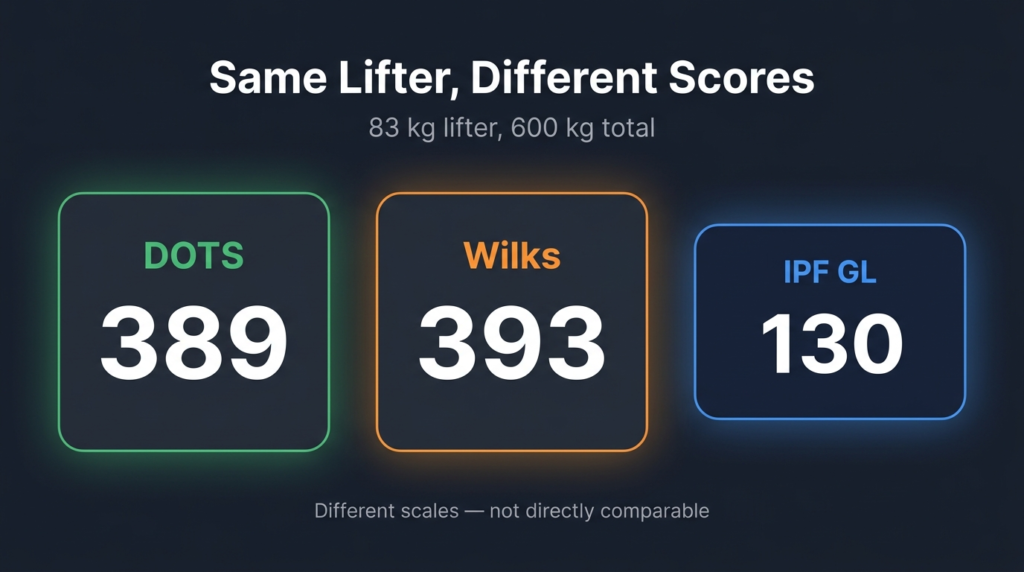
Never compare your IPF GL points directly to your DOTS or Wilks score. They measure the same thing using entirely different scales.
Which score is highest for most lifters
Most lifters score slightly higher on Wilks than on DOTS at the same bodyweight and total. The gap is usually between 5 and 20 points, depending on where you sit on the bodyweight curve. IPF GL produces a much smaller number by design.
Which formula should you actually use?
The answer is simple: use whatever your federation uses officially. That is the only score that matters at your meet.
If you train outside of competition and want a personal benchmark, DOTS is a good option. It gives a balanced view of strength across all body weights. If your federation uses Wilks, track Wilks. If you compete in an IPF affiliate, IPF GL is your number.
Tracking multiple scores
Many lifters track all three scores at the same time. This helps them see their strength across different systems. It also matters because federations and scoring methods can change over time. You can run all three scores on a calculator in just a few seconds. This shows exactly where you stand in each system. It also explains why your Wilks score can look different depending on which version is used.
Does the formula choice affect your training?
No. The goal is always the same: increase your total and manage your bodyweight. A stronger total produces a better score under every formula. No training strategy optimizes specifically for one scoring system over another.
The formula mainly matters when you compare yourself to other lifters. It also matters when you check your ranking in a specific federation.
Frequently asked questions
Which is better, DOTS or Wilks?
DOTS is more accurate across all body weights based on modern data. Wilks is more widely recognised historically. Use whichever your federation requires.
Does IPF use DOTS or Wilks?
Neither. The IPF has used IPF GL Points exclusively since 2020. DOTS and Wilks are used by non-IPF federations.
Are DOTS and Wilks scores the same number?
No. The same lifter will get different numbers under each formula. They are not directly comparable to each other.
Which scoring system is most accurate?
IPF GL ranked first in the IPF’s 2020 evaluation within its own data. DOTS ranked second and performed most consistently across all federations and bodyweights.
Can I use all three calculators on the same tool?
Yes. Enter your bodyweight and total into the scoring calculator on this page to get your DOTS, Wilks, and reference scores instantly.
Worth Knowing
No formula is perfect. Every scoring system is a mathematical approximation of a complex physical reality. What matters more than which formula you use is the direction your score moves over time.
Pick the system your federation uses, track it consistently, and focus on moving the number upward each training block.