IPF GL Points in Powerlifting: What They Are and Why They Matter
Adrian Callen
Last updated June 16, 2026
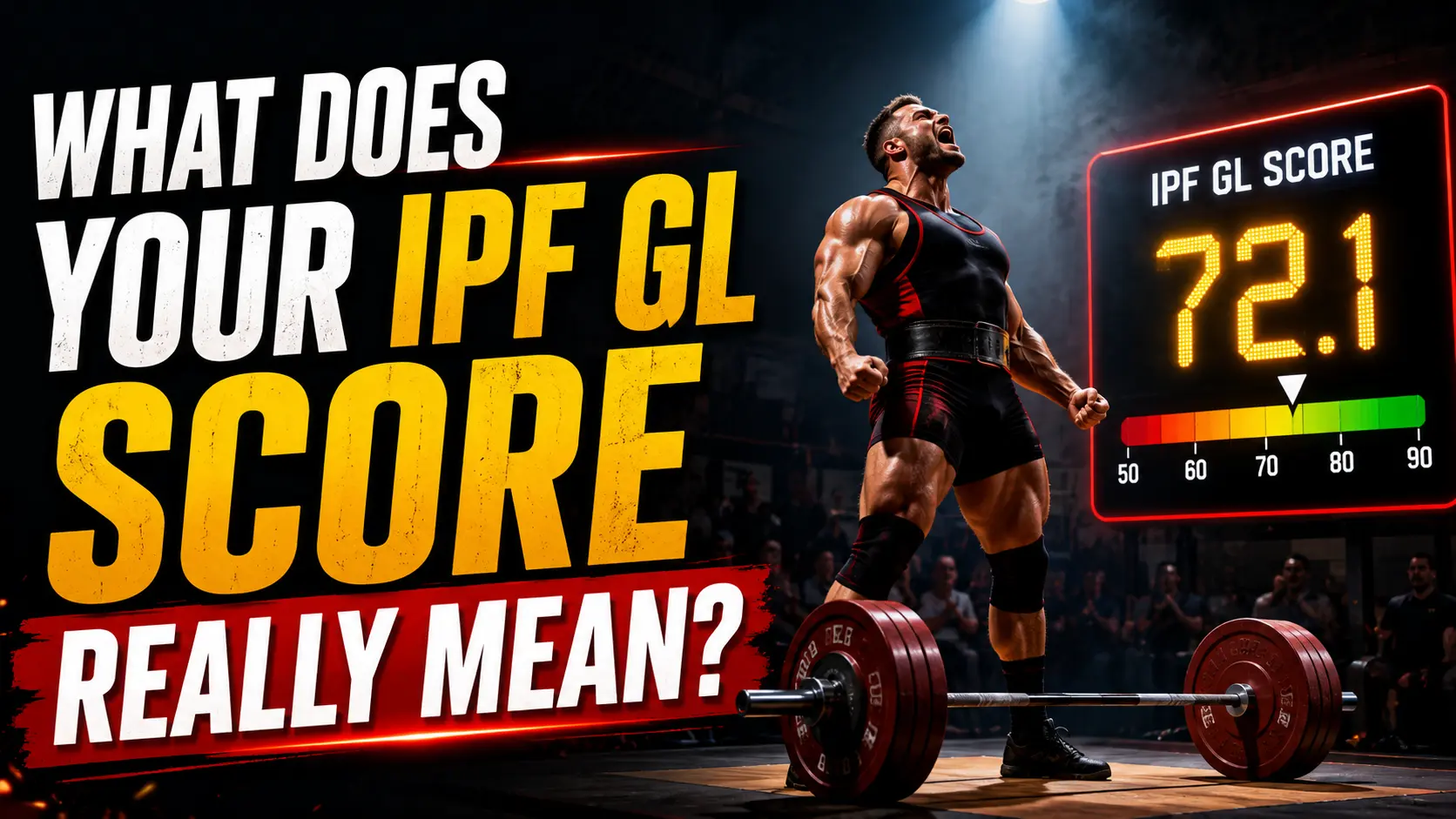
You compete in a USAPL meet. Your total is strong. But the score on your result card is not DOTS or Wilks.
It is a number between 60 and 90. That is your IPF GL score. Here is exactly what it means.
What are IPF GL points?
IPF GL Points are the official scoring system of the International Powerlifting Federation. They measure strength relative to bodyweight across all weight classes. The system replaced the previous IPF Points formula in May 2020.
The quick answer
IPF GL Points convert your powerlifting total into a single bodyweight-adjusted number. That number lets lifters from different weight classes be fairly compared on the same scale.
Who created IPF GL Points?
The IPF developed Goodlift Points in collaboration with statisticians and federation officials. The formula was introduced after an independent evaluation of five major scoring systems in early 2020. IPF GL ranked first overall for accuracy and consistency across all bodyweight ranges.
Why the IPF built its own formula
Previous systems, including the original Wilks formula, showed documented biases at extreme bodyweights. The IPF needed a formula calibrated specifically to its own competition population and world record data. Goodlift Points solved that problem using an exponential curve rather than a polynomial.
Where are IPF GL Points used?
Every IPF-affiliated federation uses IPF GL Points as its official scoring system. That covers over 100 national member federations worldwide.
Federations using IPF GL Points
In the United States, USA Powerlifting uses IPF GL exclusively. British powerlifting uses it in the UK. IPF Canada, IPF Germany, and every other national IPF affiliate follow the same standard.
Meet directors use IPF GL points for the best lifter awards. This applies at national and international championships. IPF World Championship rankings are also based on this score.
Understanding which federations use IPF GL versus DOTS or Wilks helps you know which score matters at your specific meet.
How is the Goodlift formula different from other systems?
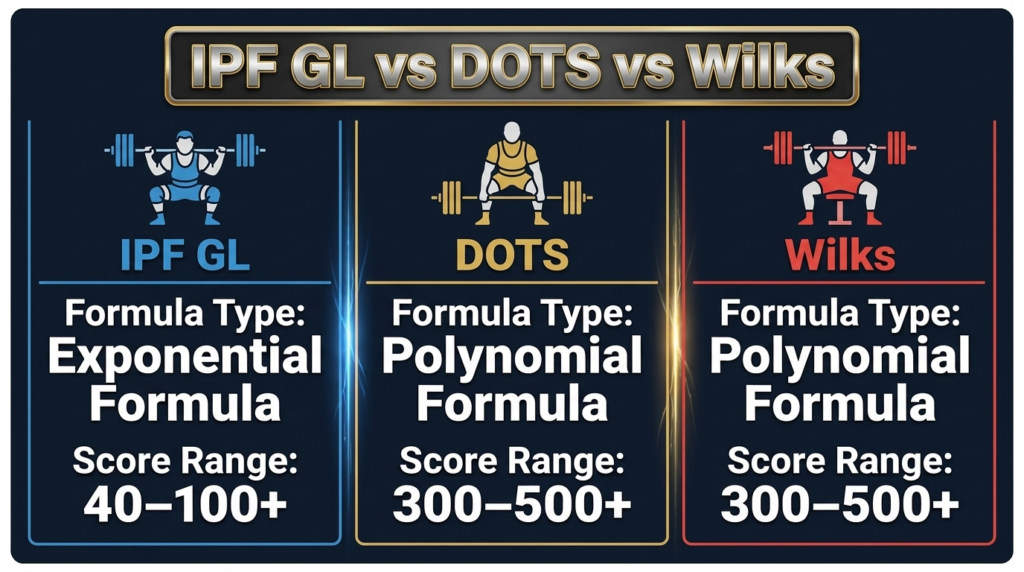
IPF GL uses an exponential curve. DOTS and Wilks both use polynomial equations. The exponential approach produces a scoring scale that runs from roughly 40 to 100 for competitive lifters rather than the 300 to 500 range DOTS produces.
What the different scale means
A 75 IPF GL score and a 380 DOTS score can represent similar levels of relative strength. The numbers look completely different because the formulas use different mathematical structures and different scales. They are not comparable directly.
The full comparison of all three systems breaks down exactly how each formula behaves differently at various bodyweights.
What do IPF GL Points actually measure?
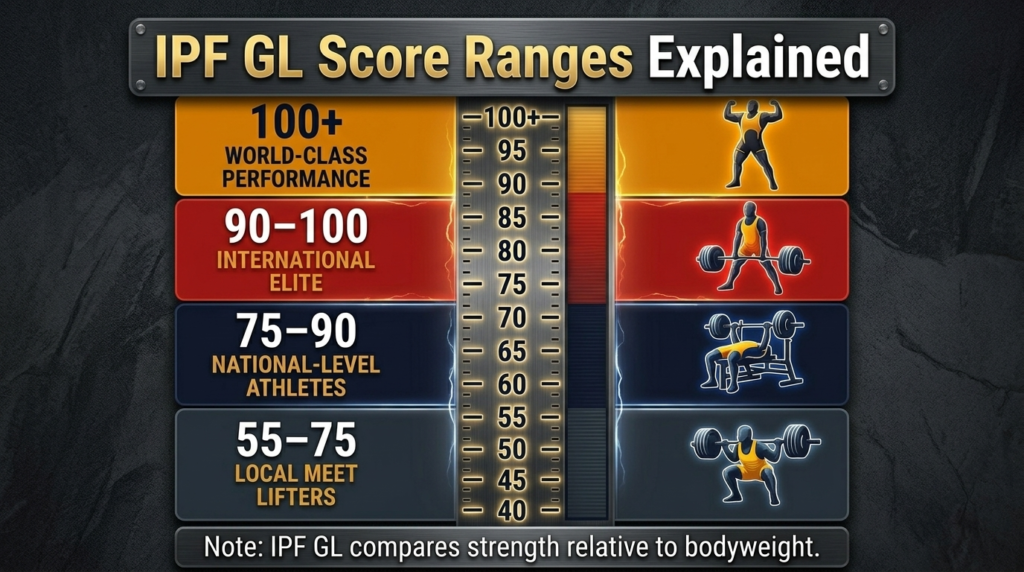
IPF GL Points measure how your total compares to elite world-record performances at your bodyweight. The formula is calibrated so that a score of 100 represents world-class performance.
The scoring scale in context
Most lifters at local meets score between 55 and 75. National-level athletes are usually between 75 and 90. Scores above 90 are common among top international lifters. A score of 100 or more is considered world-class.
Are IPF GL Points the same as IPF Points?
No, IPF Points were the system used from January 2019 to May 2020. IPF GL Points replaced them after the 2020 formula evaluation. The two systems use different formulas and produce different numbers.
Why the change happened so quickly
The IPF introduced its own points system in 2019 to replace Wilks. One year later, it was updated again to Goodlift Points after the independent evaluation confirmed IPF GL was more accurate. The transition happened fast because the data was clear.
The full story of how powerlifting scoring evolved from Wilks through to IPF GL is covered in the history of powerlifting scoring.
Can you calculate IPF GL Points outside of competition?
Yes. Any lifter training squat, bench press, and deadlift can calculate their IPF GL score using their current training totals. It works as a personal benchmark whether you compete or not.
Gym lifters in USAPL or any IPF-affiliated federation use it the same way recreational lifters use DOTS. Check it after each training block to see if relative strength is improving.
Use the IPF GL points calculator on this site to get your score instantly from your current numbers.
Frequently asked questions
What are IPF GL Points in powerlifting?
IPF GL Points are the official IPF scoring system introduced in May 2020. They measure strength relative to bodyweight using the Goodlift exponential formula.
What does GL stand for in IPF GL Points?
GL stands for Goodlift. The formula is named after the Goodlift scoring system developed for IPF competition use.
Are IPF GL Points the same as Wilks?
No. IPF GL replaced Wilks in the IPF competition in 2019 and was further updated in 2020. The two formulas use completely different mathematical approaches.
Who uses IPF GL Points?
USAPL, British Powerlifting, IPF Canada, and over 100 other national IPF affiliates use IPF GL Points as their official scoring system.
Can I calculate my IPF GL score without competing?
Yes. Enter your training total and bodyweight into the IPF GL points calculator to get your score instantly.
Now You Know the Number
IPF GL Points turn your total into one honest measure of relative strength. Every IPF affiliate federation uses this number to rank lifters and decide the best-lifter awards.