How to Improve Your DOTS and Wilks Score in Powerlifting
Adrian Callen
Last updated April 16, 2026

Your score is not moving. Your total is going up, but the number stays flat.
That happens more than most lifters expect. Knowing exactly what drives your score is the fastest way to fix it.
What actually moves your DOTS or Wilks score?
Two things control your score: your powerlifting total and your bodyweight. Your total is the sum of your squat, bench press, and deadlift. Your body weight determines the coefficient applied to that total.
Increase your total without gaining bodyweight, and your score goes up. Gain bodyweight without increasing your total, and your score drops. Both variables matter every single training block.
The simple math behind it
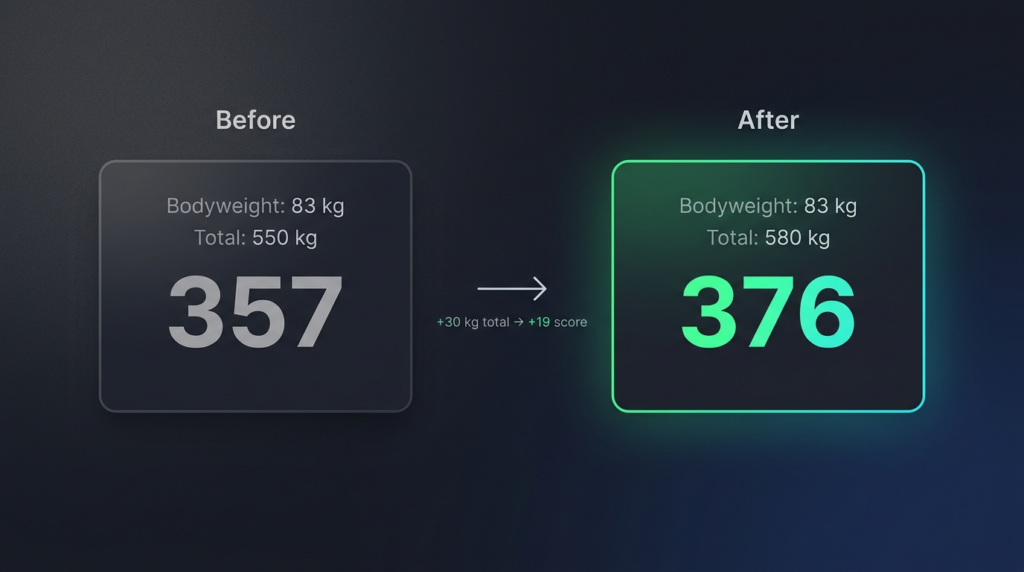
A male lifter at 83 kg with a 550 kg total scores around 357 DOTS. Add 30 kg to that total while staying at 83 kg, and the score jumps to around 376. That 19-point gain came purely from a stronger total with no bodyweight change.
Which lift contributes most to your score?
All three lifts contribute equally in terms of formula mechanics. Your squat, bench press, and deadlift add directly to your total. A kilogram added to any lift is worth exactly the same as a kilogram added to any other.
In practice, most lifters have one lift that lags significantly behind the other two. That weak lift is where your biggest score gains are hiding.
Find your weakest lift first
Compare your three lifts to your total. A balanced raw lifter typically squats around 38%, benches around 26%, and deadlifts around 36% of their total. If your bench is at 20% of your total, it is pulling your score down more than your training split reflects.
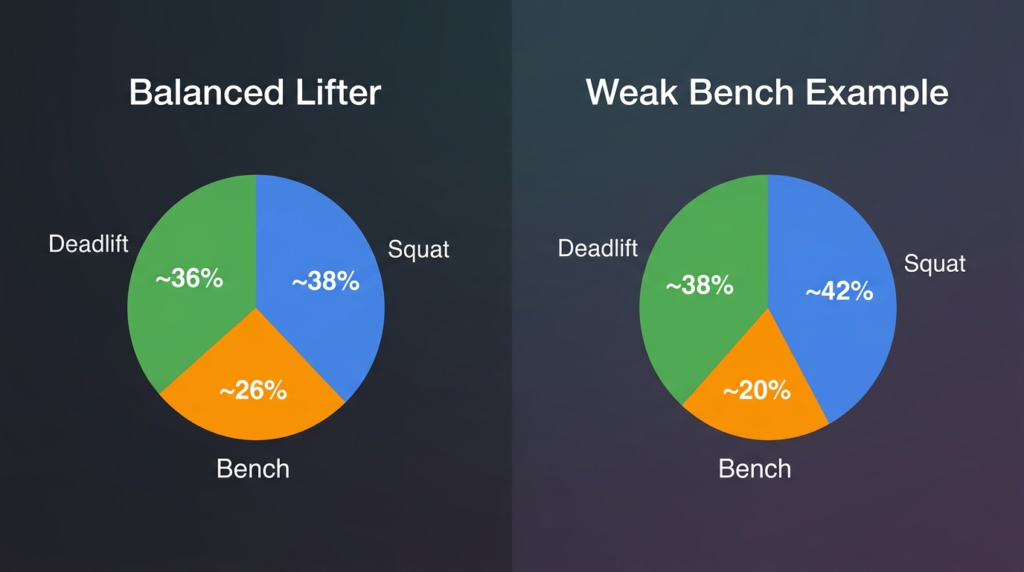
When lifters compare their numbers to level benchmarks, they understand their performance better. They can see how each lift compares to competitive standards. This makes it easy to spot which lift is lagging behind.
Does losing bodyweight improve your score?
Sometimes. The relationship between bodyweight and your coefficient is not linear. Dropping from 84 kg to 83 kg to move into a lower weight class shifts your coefficient slightly upward. But if that cuts your strength in any of your three lifts, your total drops, and your score follows.
A weight cut only helps your score if your total stays the same or goes up after the cut. Most lifters underestimate how much a hard cut affects their squat and deadlift on meet day.
When a weight cut makes sense
Cutting weight can help your score in some cases. It works best when you are above your weight class limit. And when you can cut weight without hurting your performance. A 2 to 3 kg water cut the day before weigh-in is manageable for most experienced lifters. Anything beyond that starts eating into total potential.
The federation breakdown also shows how weight class rules work. It explains how different organizations apply these rules with their scoring systems. This affects when and how lifters cut weight before weigh-ins.
How does training frequency affect your score?
Higher training frequency on weak lifts accelerates total growth. A lifter benching once per week who moves to three sessions per week typically sees faster bench progress. That improvement feeds directly into a higher total and a better score.
Frequency alone is not enough. The quality of each session, progressive overload, and recovery all determine how fast your total grows. But if one lift is clearly behind, adding volume to it is the most direct route to a higher score.
Peaking for competition
Matter in, pick your score at a meet should be higher than your score in training. A proper peaking cycle of 4 to 6 weeks before competition reduces fatigue and lets your true strength express itself on the platform. Most lifters leave 5 to 10% of their total on the table by not peaking properly.
Should you focus on DOTS or Wilks when training?
Neither. Train to increase your total and manage your bodyweight. The formula applied to those two numbers is decided by your federation, not your training program.
Lifters who focus too much on which formula gives a higher score are wasting energy. You should channel that energy into your gym training. A stronger total improves your score under every system. Comparing all major scoring formulas shows one thing clearly. No training method is built for just one formula.
How often should you recalculate your score?
Once per training block is enough. A standard block runs 8 to 16 weeks. Check your score at the start and end of each block. It helps you see what really improved. Whether your strength improved relative to your body weight or just your total went up.
Checking more often than that introduces noise. Week-to-week fluctuations in bodyweight alone can shift your score by 5 to 10 points without any real change in strength.
Run your current numbers through the calculator at the end of each block and record the result alongside your total and bodyweight. Three data points tell you more than any single score.
Frequently asked questions
What is the fastest way to improve my DOTS score?
Increase your total while keeping your bodyweight stable. Adding strength to your weakest lift produces the fastest score gains.
Does losing weight always improve my score?
No. A weight cut only helps if your total stays the same or rises after the cut. Losing strength during a cut lowers your score.
How long does it take to raise my score by 20 points?
For most intermediate lifters, a 20-point gain takes one to two serious training cycles of 12 to 16 weeks each.
Should I focus on one lift to improve my score?
Focus on your weakest lift first. One lagging lift holds back your total more than evenly distributed weakness across all three.
Does my score improve automatically as I get stronger?
Only if your body weight stays controlled. Getting stronger while gaining significant bodyweight can keep your score flat even as your total climbs.
Keep Pushing
Your score changes when your total moves. That is the whole game.
Matter in Pick your weakest lift. Train it more with focused work. Then check your numbers again after your next training block using the scoring tool on the same website.