How Age Coefficients Work for Masters Powerlifters Using DOTS and Wilks
Adrian Callen
Last updated May 1, 2026

You are 45 years old and posting numbers that would have been competitive at 25.
But when you compare your DOTS or Wilks score to open division lifters, the gap feels unfair. Your body is not the same machine it was two decades ago.
That is exactly what age coefficients exist to fix.
Do DOTS and Wilks scores account for age?
No. The base DOTS and Wilks formulas only account for bodyweight and total. Age is not part of either equation. A 50-year-old lifter and a 25-year-old lifter can have the same base score. This happens when their total and body weight are the same.
How age adjustments are applied
Federations layer a separate age coefficient on top of the base score for master divisions. The most widely used system is the McCulloch coefficient. It applies a multiplier based on the lifter’s exact age to produce an age-adjusted score.
What is the McCulloch coefficient?
The McCulloch coefficient is an age-based multiplier. It is added to a lifter’s DOTS or Wilks score. It was created by Win McCulloch. The goal is to give older lifters a fair comparison with younger lifters.
The multiplier starts at 1.0 for lifters around 40 years old. It increases gradually with each year of age. A 50-year-old lifter receives a higher multiplier than a 45-year-old. A 60-year-old receives a higher multiplier still.
How the adjustment changes your score
A master’s lifter with a base DOTS score of 360 at age 55 might receive a McCulloch multiplier of around 1.15. That produces an age-adjusted score of approximately 414. That adjusted number is what decides the best lifter in master divisions, not the raw 360.
Best Lifter award criteria at most federations use the age-adjusted score for masters. This is because raw scores do not account for age differences. The adjusted score makes the comparison fair.
Which age groups qualify as masters in powerlifting?
Master’s divisions typically start at age 40. Most federations break masters into several subcategories.
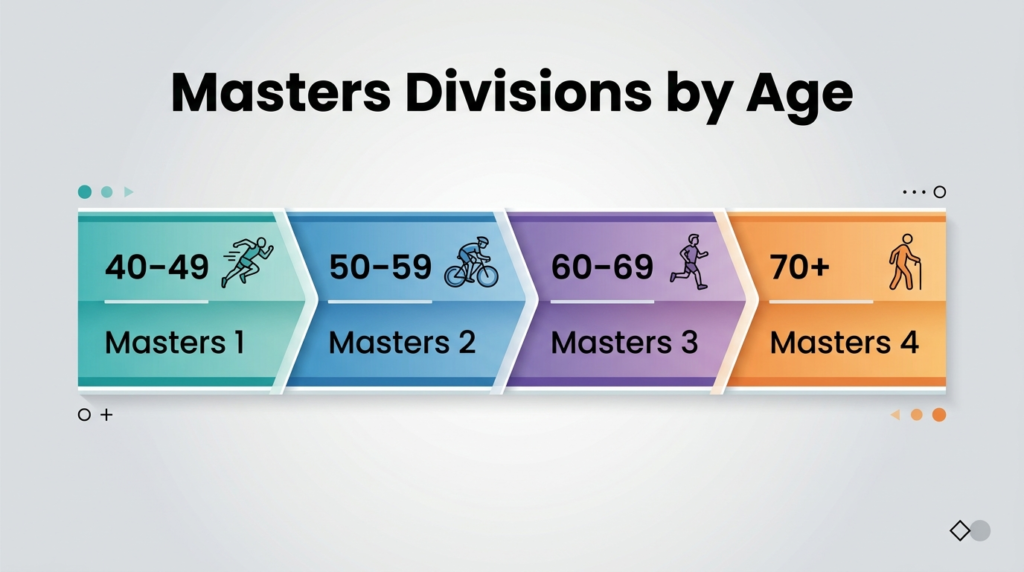
Some federations also have a sub-master’s category for lifters between 33 and 39. Rules vary by federation, so always check your specific rulebook.
Junior and open lifters are not age-adjusted
Age coefficients only apply in master divisions. Open and junior lifters compete on raw DOTS or Wilks scores with no age adjustment. A 22-year-old open lifter and a 38-year-old open lifter are scored the same way. Their base scores are identical if their totals and body weight match.
What is a good age-adjusted score for master’s lifters?
The adjusted score uses the same scale as DOTS or Wilks. A master’s lifter scoring above 400 is at an advanced level. Scores above 450 are considered elite in most federations.
Master’s world record holders
The strongest master lifters in the world post age-adjusted scores well above 500. That is comparable to elite open division performance. Reaching that level takes many years of consistent training. It also depends on a strong natural ability. The age multiplier helps, but it is not enough on its own.
Do all federations use McCulloch for masters scoring?
No. Federation rules vary. The USPA and several other non-IPF federations use McCulloch coefficients for masters’ best lifter awards. The IPF uses its own age-adjusted formula specific to the IPF GL Points system.
Always check which age coefficient your federation uses. Different organizations use different systems. So scores may not match across federations. An adjusted score from a USPA meet is not directly comparable to an adjusted score from a USAPL meet.
Which federations use which age system
The federation breakdown shows which systems each organization uses. This includes both base scores and age adjustments. Knowing both is important for master lifters. It helps when competing across different federations.
Can masters lifters compare their scores to open division lifters?
Using raw base scores, yes. A 52-year-old lifter with 370 DOTS and a 28-year-old with 370 DOTS are equal. They show the same strength for their body size. Age is not included in the base formula.
Using age-adjusted scores, no. The adjusted number is only meaningful within the master’s competition. The age adjustment is used to rank master lifters fairly among themselves. The purpose is not to compare them with younger open lifters.
Why this distinction matters
Some masters lifters get discouraged comparing their base DOTS or Wilks score to open division standards. A 58-year-old posting 340 DOTS is performing exceptionally for their age. That same score in an open 25-year-old is intermediate.
Benchmark ranges by experience level are useful. They are mostly based on open division performance. Master lifters should focus more on their age-adjusted score. This gives a better view of their own progress.
How should master lifters track their score over time?
Track both numbers. Record your base DOTS or Wilks score and your age-adjusted score after every training block. Your base score tells you if your absolute relative strength is holding or improving. Your adjusted score tells you how you are performing within your age division.
As you get older, your base score may drop slightly. This can happen even with consistent training. If your adjusted score is rising, your performance is still improving. That is an important and motivating sign for masters lifters.
Use the powerlifting score calculator on this page to check your base score after each training block.
Frequently asked questions
Does DOTS score account for age?
No. Base DOTS only accounts for bodyweight and total. Age adjustments are applied separately using the McCulloch coefficient in masters divisions.
What is the McCulloch coefficient in powerlifting?
It is an age-based multiplier applied to a base DOTS or Wilks score. Older lifters receive a higher multiplier to account for natural strength decline with age.
When do master’s age coefficients start applying?
Most federations apply age coefficients from age 40 onward. Subdivisions typically run in 10-year increments up to 70 and above.
Can I compare my age-adjusted score to open division lifters?
No. Age-adjusted scores are only meaningful within master competitions. Use your base DOTS or Wilks score for comparison with open-division athletes.
Is a 400 age-adjusted DOTS score good for a master’s lifter?
Yes. A score of 400 with age adjustment is considered advanced. This applies to most federations and weight classes in masters’ competition.
Age Is in the Formula
Your base score measures raw relative strength. Your age-adjusted score measures how that strength holds up against time.
Both numbers give useful information. Track them together for a complete view. You can see where your strength stands at every stage of training.